24/7 Emergency Water Removal & Cleanup in Honolulu
24/7 emergency water removal and cleanup in Honolulu and surrounding areas. Insurance billing accepted. Call (808) 349-3407.
Standing water does not wait. Within the first hour after a pipe bursts, a washing machine line fails, or a storm pushes water under your door, moisture is already wicking into drywall, saturating subfloor panels, and beginning the clock on microbial growth. Emergency water removal is the race to get that water out and stop the spread before it becomes a structural problem, a mold problem, or both. The work is faster, more equipment-intensive, and more time-sensitive than most homeowners expect.
What emergency water removal and cleanup actually involves
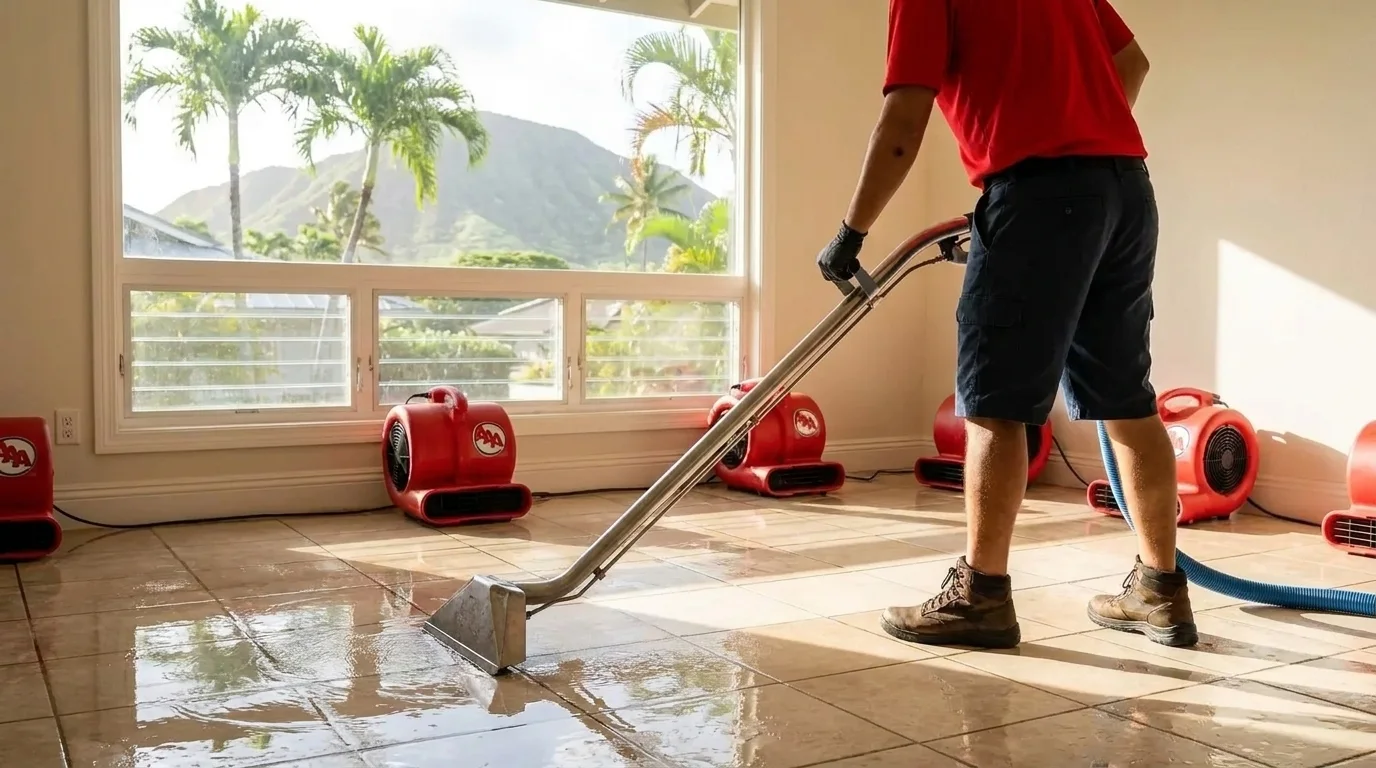
Water removal is not mopping and running a box fan. Professional extraction removes hundreds or thousands of gallons of water that a wet-vac cannot reach, including water trapped beneath flooring, inside wall cavities, and under baseboards. After extraction, the real work begins: industrial air movers and low-grain refrigerant (LGR) dehumidifiers run continuously, sometimes for several days, to pull residual moisture from building materials before it causes secondary damage.
In Honolulu, the baseline humidity is already high. The Pacific trade winds keep the air moving outdoors, but inside a closed home after a water loss, ambient humidity climbs fast and drying slows significantly compared to drier mainland climates. Equipment staging and air circulation patterns matter more here than in a desert environment, and drying timelines are calibrated accordingly.
The category of water involved also shapes every decision. Clean water from a supply line (Category 1) is handled differently than gray water from an overflowing dishwasher or washing machine (Category 2), and both are handled very differently from black water involving sewage or floodwater that has contacted the ground (Category 3). Category 2 and 3 losses require containment, PPE, and antimicrobial treatment that a Category 1 response does not.
Our process
1. Arrival and safety assessment Before any equipment enters the structure, the source of water is confirmed stopped and the space is checked for electrical hazards. In Category 2 or 3 losses, PPE protocols are staged before crew members enter affected areas.
2. Standing water extraction Truck-mounted or portable high-capacity extractors remove standing water from hard surfaces and pull free water from carpet and pad. Extraction is the single highest-leverage step: every gallon removed mechanically is water that does not have to evaporate through the drying phase.
3. Material evaluation and controlled demolition (when needed) Moisture meters and thermal imaging cameras identify water that has migrated beyond the visible loss area. Saturated drywall, insulation, and flooring that cannot be dried in place are removed to prevent mold colonization. Flood cuts (horizontal drywall cuts above the waterline) expose wall cavities to airflow and are a standard practice on losses where water has been present for more than a few hours.
4. Structural drying with monitored equipment placement Air movers are positioned to create a vortex effect across wet surfaces, and LGR dehumidifiers are sized to the cubic footage of the affected space. Equipment is not set and forgotten: moisture readings are logged at each visit so the drying curve can be tracked and equipment adjusted or removed as materials reach target moisture content.
5. Final moisture verification and documentation Drying is not complete until affected materials reach acceptable moisture levels confirmed by calibrated meters. A written moisture log documents the start and end readings for each affected material, which is the record your insurance adjuster will ask for.
What separates a good water removal and cleanup response from a bad one
The most common failure in emergency water removal is stopping too early. Surface materials dry faster than the structural layers beneath them. A wood floor can feel dry underfoot while the subfloor below reads at 25 to 30 percent moisture content, well above the threshold where mold begins to colonize. Operators who rely on visual inspection instead of calibrated meters routinely miss this.
A second common failure is under-sizing equipment. One dehumidifier for a 1,500-square-foot loss area will not achieve the air changes per hour needed to drive drying in Hawaii’s ambient humidity. Proper equipment load calculations account for the volume of wet material, the ambient conditions, and the category of loss.
Insurance adjusters look for a moisture log with date-stamped readings, photos of equipment placement, and documentation of the water category and affected materials. Without that paper trail, scope disputes are common. A thorough documentation package protects the homeowner as much as it supports the claim.
What does emergency water removal and cleanup cost?
Typical costs for water removal and cleanup vary widely based on the size of the loss, the category of water, and how much structural material requires removal. Most homeowners pay somewhere in the ranges below, which reflect industry-typical figures and are not quotes from AAA Water Damage Restoration & Carpet Care.
| Scenario | Typical industry range |
|---|---|
| Single room, clean water (Category 1) | $1,200 - $3,500 |
| Multi-room, clean water with subfloor saturation | $3,500 - $7,000 |
| Gray water loss (Category 2), 1-2 rooms | $2,500 - $6,000 |
| Black water or sewage (Category 3) | $4,000 - $12,000+ |
| Whole-floor or slab-on-grade flooding | $7,000 - $20,000+ |
| Crawl space or under-structure water intrusion | $2,000 - $8,000 |
Every loss is different, and AAA Water Damage Restoration & Carpet Care provides a written scope of work before any work begins so there are no surprises. Standard homeowners insurance policies typically cover sudden and accidental water losses (burst pipes, appliance failures, storm intrusion through a compromised roof or window) but generally exclude gradual leaks and maintenance-related damage.
Seasonal and regional considerations
Honolulu does not experience freeze-thaw pipe failures, but the island’s wet season (roughly November through March) brings sustained rainfall that can overwhelm older drainage systems and push water into ground-floor slabs and crawl spaces. Homes in lower-lying areas of the Ewa Plain and parts of Kalihi are particularly susceptible to storm-driven intrusion during heavy Kona wind events, when rain falls from the south and west rather than the typical northeast trade wind direction that most rooflines and drainage grades were designed around.
Hawaii’s warm, humid baseline also means mold can begin colonizing wet materials faster than in temperate climates. The 48 to 72-hour window often cited for mold onset is a conservative estimate in mainland conditions; in Honolulu’s heat and humidity, that window can be shorter. Speed of response and speed of water removal both matter more here.
Service area
AAA Water Damage Restoration & Carpet Care responds to emergency water removal and cleanup calls throughout Honolulu and the surrounding communities, including Pearl City, Aiea, Kailua, Kaneohe, Ewa Beach, Kapolei, and Mililani. Dedicated service-area pages for each community link back to this page for full process and pricing detail.
If water is in your home right now, the next step is a moisture assessment, not a waiting game. Call AAA Water Damage Restoration & Carpet Care at (808) 349-3407 any time, day or night, to get extraction equipment moving toward your address.
Frequently Asked Questions
Does homeowners insurance cover emergency water removal and cleanup?
How long does structural drying typically take after a water loss?
What is the difference between Category 1, 2, and 3 water, and why does it matter for removal and cleanup?
What should I do while waiting for the water removal crew to arrive?
Why is thermal imaging used during emergency water removal, and what does it find that moisture meters miss?
Looking for the best emergency water removal & cleanup company in Honolulu?
AAA Water Damage Restoration & Carpet Care provides emergency water removal & cleanup in Honolulu, HI and the surrounding area. We answer calls 24/7 — call (808) 349-3407 for immediate help.
Need Emergency Water Removal & Cleanup now?
We respond 24/7 across Honolulu and surrounding HI cities.
Related Coverage
- Our Restoration Services
- Contact AAA Water Damage Restoration & Carpet Care
- 24/7 Emergency Water Removal & Cleanup in Aiea
- 24/7 Emergency Water Removal & Cleanup in Aina Haina
- 24/7 Emergency Water Removal & Cleanup in Diamond Head
- 24/7 Emergency Water Removal & Cleanup in East Honolulu
- 24/7 Emergency Water Removal & Cleanup in Ewa Beach
- 24/7 Emergency Water Removal & Cleanup in Hawaii Kai
- 24/7 Emergency Water Removal & Cleanup in Heeia
- 24/7 Emergency Water Removal & Cleanup in Hickam Housing
- 24/7 Emergency Water Removal & Cleanup in Kahala
- 24/7 Emergency Water Removal & Cleanup in Kahaluu
- 24/7 Emergency Water Removal & Cleanup in Kailua
- 24/7 Emergency Water Removal & Cleanup in Kaimuki
- 24/7 Emergency Water Damage Restoration in Honolulu