
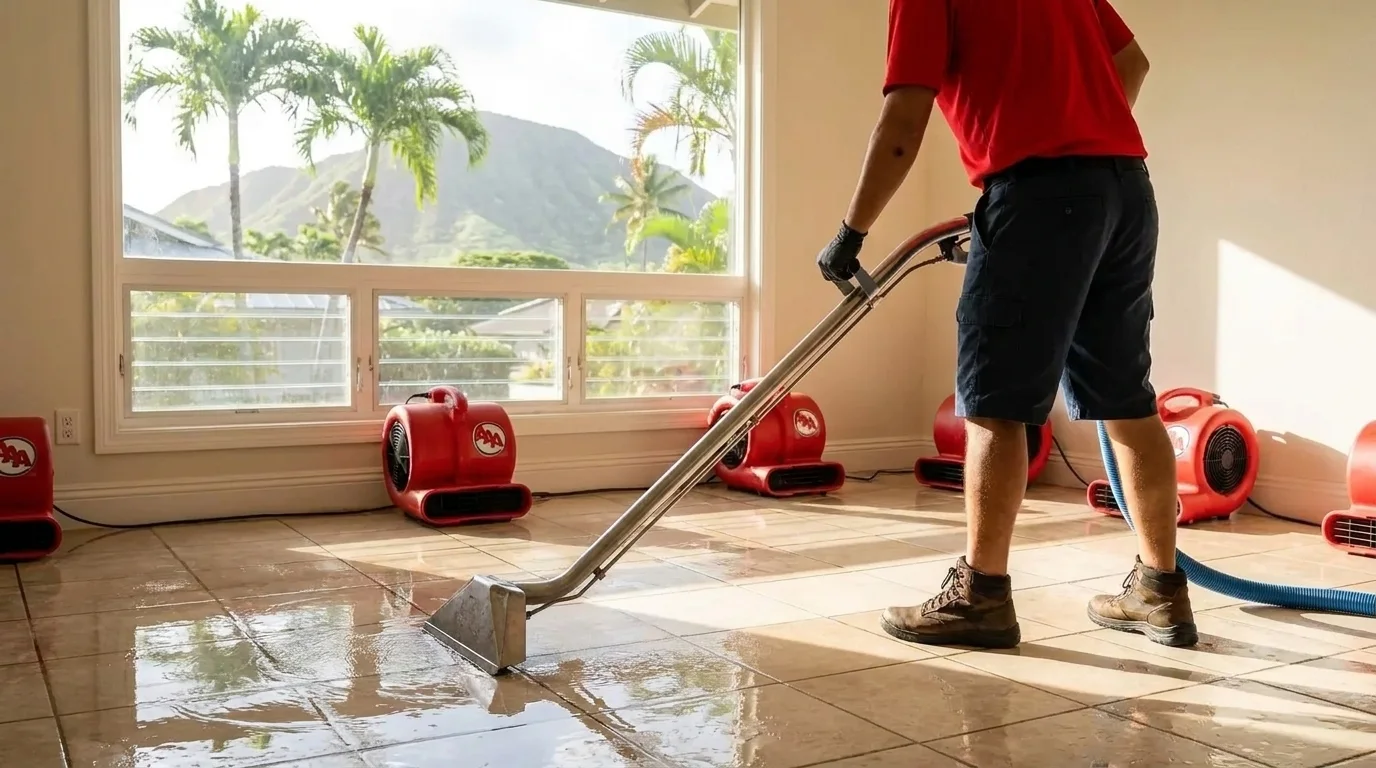
24/7 Emergency Water Removal & Cleanup in Kaimuki
24/7 emergency water removal and cleanup in Kaimuki, HI. Insurance billing accepted. Call (808) 349-3407.
Our technicians are dispatched from our Honolulu, HI headquarters and are typically on-site in Kaimuki within 60 minutes of your call.
Single-wall construction soaks up water the way a sponge soaks up rain, and in Kaimuki that matters the moment a supply line lets go or a storm pushes runoff through a carport door. The plantation-era and early-1900s wood-frame homes that line the streets between Waialae Avenue and Wilhelmina Rise were built before modern moisture barriers existed, which means standing water reaches structural framing in minutes, not hours. When that happens, the call to (808) 349-3407 connects you to a crew available around the clock, every day of the year.
Why Kaimuki Properties See Water Damage Differently
Kaimuki’s housing stock is one of Honolulu’s oldest, and age shows up in the plumbing first. Galvanized supply pipes that were standard in mid-century construction corrode from the inside out, narrowing over decades until pressure spikes crack them at fittings. Drain lines in the same vintage homes are often undersized by today’s standards, so a heavy rain event or a grease-line backup at a commercial kitchen along the Waialae Avenue business district can push water back into connected residential units before anyone realizes there is a problem.
Hillside lots add a second layer of risk. Properties on Maunalani Heights and Wilhelmina Rise sit on grades that channel storm runoff directly toward foundations and carport slabs. That water does not pool politely at the perimeter; it follows the path of least resistance into crawl spaces, under slab edges, and through gaps in original concrete block walls. By the time it appears inside, it has already been traveling through the structure for some time.
Ohana units, common throughout 96816, create an occupied-home dynamic that affects how mitigation gets planned. Two households sharing a single structure means coordinating access, protecting personal property in both units, and keeping noise and disruption at a level that lets people stay in place when possible.
Our Emergency Water Removal and Cleanup Process in Kaimuki
The first priority on arrival is stopping water movement. That means locating the source, whether a burst galvanized fitting under the house or storm intrusion at a low foundation vent, and confirming it is controlled before equipment goes in.
Once the source is addressed, the focus shifts to extraction. Standing water in single-wall homes travels fast along wall cavities because there is no insulation or vapor barrier slowing it down. Truck-mounted extraction pulls surface water quickly, but the real work is identifying how far moisture has migrated using thermal imaging and calibrated moisture meters. In older plaster-over-lath walls, the surface can read close to dry while the lath behind it holds significant saturation.
Drying in Kaimuki’s climate requires attention to ambient humidity. Honolulu’s trade winds keep outdoor humidity elevated year-round, which means simply opening windows does not accelerate drying the way it might in a drier climate. Industrial dehumidifiers and directed airflow equipment create a controlled drying environment inside the structure regardless of what the outdoor air is doing. Moisture readings are logged at each visit so the drying curve is documented, not estimated.
All affected materials are assessed against drying standards before equipment is removed. Wood framing that does not reach target moisture content stays in the drying protocol until it does.
Reaching Kaimuki for Water Emergencies
The crew dispatches from Honolulu and reaches Kaimuki via Waialae Avenue or the H-1 to the Kaimuki exits depending on traffic and time of day. The Waialae Avenue corridor can back up during restaurant hours near the business district, so routing adjusts in real time. Calls are answered 24 hours a day, seven days a week, including holidays, because water does not wait for business hours.
Working with Insurance on Kaimuki Water Losses
Most homeowner policies cover sudden and accidental water losses, which includes burst pipes and certain storm intrusion events. The documentation process matters here: photos of affected materials, moisture readings at multiple points, and a written scope of work give the adjuster what they need to process the claim without unnecessary back-and-forth. The crew photographs conditions on arrival, before any extraction begins, so the initial state of the loss is on record.
For commercial properties along Waialae Avenue, business interruption coverage questions often come up alongside property damage claims. Having a clear, timestamped record of when the loss was discovered and what was done in response supports those conversations with the carrier.
Local Note
Single-wall construction is the detail that surprises people unfamiliar with Kaimuki’s housing. In a standard mainland home, a wet wall cavity is bounded by insulation and a vapor barrier that slow lateral spread. In a single-wall home, the interior board is the exterior board, and water that gets behind it has a direct path along every stud bay from floor to ceiling. Crews working in these homes probe higher on the wall than they would in a newer structure, because moisture readings at knee height can look fine while the top of the same wall bay is still holding water. Getting that wrong means leaving a mold condition behind a wall that passed a surface check.
Emergency Water Removal & Cleanup in Kaimuki: Service Coverage
Frequently Asked Questions
How fast can you arrive for emergency water removal & cleanup in Kaimuki?
How quickly can you reach a home on Wilhelmina Rise or Maunalani Heights for emergency water removal and cleanup?
Are the older wood-frame homes in the 96816 ZIP code harder to dry out after a water loss?
Can a grease-line backup at a Waialae Avenue commercial kitchen affect neighboring residential units?
What does the water removal process look like inside a Kaimuki ohana unit where both households need to stay in place?
How long does emergency water removal and cleanup typically take from first call to dry structure in a Kaimuki home?
Will my homeowners insurance cover emergency water removal & cleanup in Kaimuki?
Emergency Water Removal & Cleanup response in Kaimuki
Most Kaimuki calls see a technician on-site within 60 minutes from our Honolulu headquarters.
Nearby & Related
- 24/7 Emergency Water Removal & Cleanup in Honolulu
- Restoration Services in Kaimuki
- Mold Remediation in Kaimuki
- 24/7 Emergency Water Damage Restoration in Kaimuki
- 24/7 Emergency Water Removal & Cleanup in Aiea
- 24/7 Emergency Water Removal & Cleanup in Aina Haina
- Contact AAA Water Damage Restoration & Carpet Care