
Mold Remediation in Urban Honolulu
24/7 mold remediation in Urban Honolulu, HI. Insurance billing accepted. Call (808) 349-3407.
Our technicians are dispatched from our Honolulu, HI headquarters and are typically on-site in Urban Honolulu within 60 minutes of your call.
Honolulu’s trade winds and year-round humidity create conditions that few mainland cities ever experience: warm, moisture-laden air pushes through window gaps, infiltrates attic spaces, and lingers inside walls long after a rainstorm passes. In Urban Honolulu, where older concrete-block and wood-frame buildings sit close together and air conditioning is often minimal, mold can colonize a damp surface within 24 to 48 hours of a moisture event. If you are noticing a musty odor, discoloration on ceilings or baseboards, or unexplained respiratory irritation indoors, the problem may already be deeper than the surface suggests.
Why Urban Honolulu Properties See Mold Issues
Honolulu’s climate sits in a narrow band that mold thrives in: temperatures rarely drop low enough to slow spore activity, and relative humidity frequently climbs above 60 percent even on clear days. Properties on the windward-facing sides of buildings accumulate moisture faster than their neighbors, and rooftop mechanical equipment, plumbing chases, and concrete walls that sweat during temperature shifts all create hidden wet zones.
The city’s housing stock adds another layer of complexity. A significant portion of Urban Honolulu’s residential buildings date to the post-World War II construction boom, when concrete masonry units became the dominant building material for everything from single-family homes to low-rise apartment blocks. Concrete is porous. When a supply line drips inside a CMU wall cavity or a roof membrane fails, water wicks into the block and stays there, invisible to the eye and often undetected by a standard moisture reading at the surface. By the time a stain appears on the interior plaster, mold has typically been active in the cavity for weeks.
High-density neighborhoods compound the problem. Shared walls between units mean one unit’s plumbing failure can introduce moisture into a neighbor’s space without either party realizing it until the smell becomes undeniable.
Our Mold Remediation Process in Urban Honolulu
Effective mold remediation is not surface cleaning. It is a structured process that starts with finding every moisture source and ends with verification that spore counts have returned to normal background levels.
The process begins with a thorough inspection using thermal imaging and calibrated moisture meters to locate wet zones behind walls, under flooring, and above ceiling tiles. Readings at the surface of a concrete or plaster wall can look acceptable while the substrate behind it remains saturated. In Honolulu’s climate, that distinction matters.
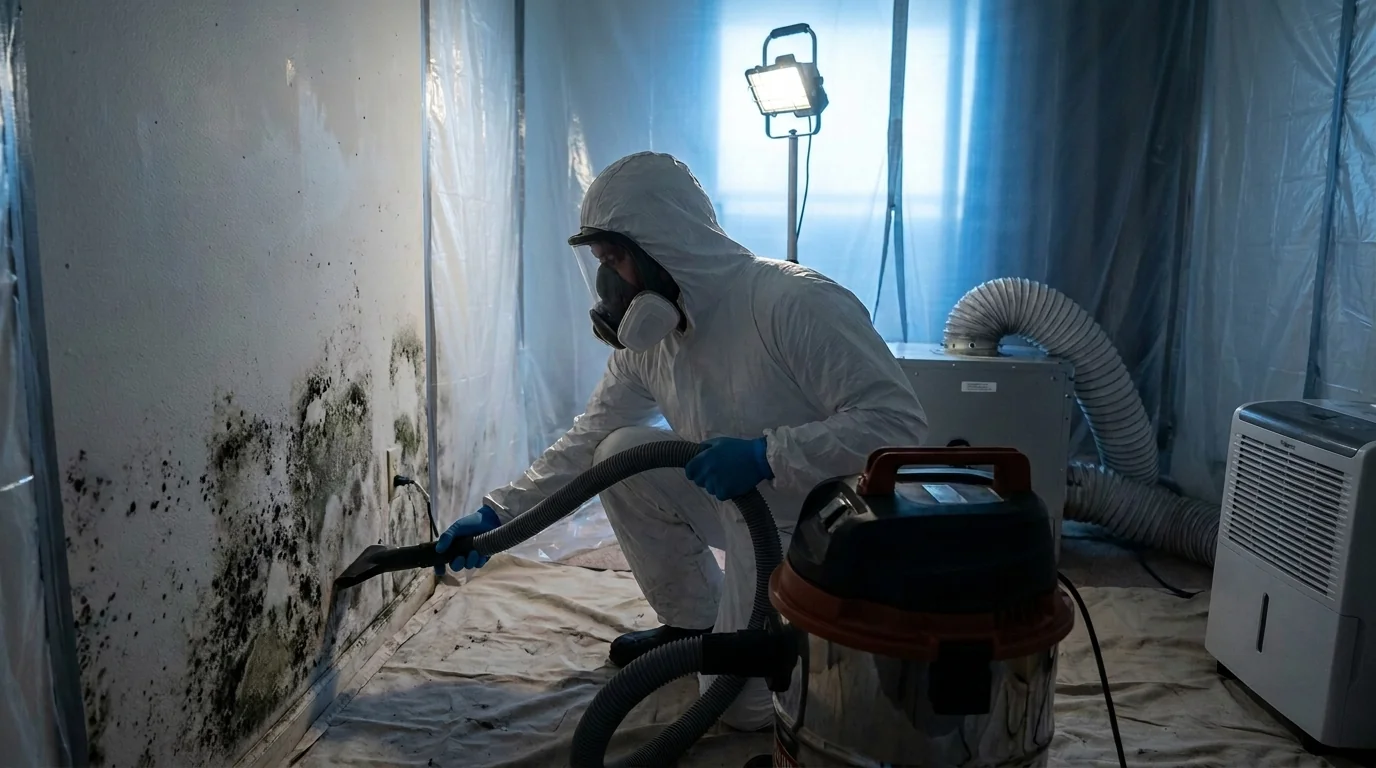
Once the affected area is mapped, containment goes up: heavy-gauge poly barriers, negative air pressure, and HEPA-filtered air scrubbers running continuously. Containment prevents cross-contamination to unaffected rooms and is especially important in open-plan condominiums and older homes with central air returns that can carry spores through ductwork.
Mold-affected materials are removed, bagged, and disposed of per applicable guidelines. Structural surfaces that can be cleaned are treated with EPA-registered antimicrobial agents. Drying equipment remains in place until moisture readings confirm the substrate has reached acceptable levels, not just the surface. Final clearance documentation is available upon request for insurance carriers or property managers.
Urban Honolulu Insurance and HOA Coordination
Mold claims in Hawaii often involve questions about the original moisture source, because insurers distinguish between sudden-and-accidental water damage (typically covered) and long-term seepage or humidity-related growth (often not). Thorough documentation of the source, the affected area, and the timeline is essential to a successful claim.
For condominium owners in Urban Honolulu, HOA master policies and individual unit policies frequently overlap in ways that are not immediately obvious. Common-area plumbing that leaks into a unit wall is one of the most contested scenarios in local condo claims. Detailed photographs, moisture logs, and written scope of work help establish the chain of causation that adjusters need to make a coverage determination.
AAA Water Damage Restoration and Carpet Care documents losses in the format most carriers and property managers expect, which reduces back-and-forth and keeps the project moving.
Local Note
One pattern that comes up repeatedly in Urban Honolulu’s older concrete-block homes: the exterior wall cavity between the CMU and the interior furring is often uninsulated and unventilated. When humid outside air meets the cooler interior surface of that cavity during air-conditioned hours, condensation forms on the back of the drywall or plaster. The occupant never had a leak, the roof is intact, and yet mold appears along the lower courses of interior walls every wet season. This is a building-science issue specific to Hawaii’s climate and construction era, and it requires a different remediation approach than a straightforward water-damage mold job. Addressing the moisture source, not just the visible growth, is the only way to prevent recurrence.
If you are seeing mold in Urban Honolulu and are not sure whether you had a leak or whether your building’s construction is the culprit, call (808) 349-3407. AAA Water Damage Restoration and Carpet Care responds around the clock and can help you identify what is actually driving the problem before any remediation work begins.
Mold Remediation in Urban Honolulu: Service Coverage
Frequently Asked Questions
How fast can you arrive for mold remediation in Urban Honolulu?
Does Honolulu's year-round humidity mean mold can return after remediation even if there was no plumbing leak?
How quickly can you reach properties in Urban Honolulu for a mold emergency?
My condo's HOA says the mold in my unit came from a common-area pipe. How does that affect the remediation process?
Are the concrete-block homes common in Urban Honolulu harder to remediate than wood-frame construction?
What does the mold remediation process look like from start to finish, and how long does it typically take?
Will my homeowners insurance cover mold remediation in Urban Honolulu?
Mold Remediation response in Urban Honolulu
Most Urban Honolulu calls see a technician on-site within 60 minutes from our Honolulu headquarters.