Commercial Restoration in Urban Honolulu
24/7 commercial restoration in Urban Honolulu, HI. Insurance billing accepted. Call (808) 349-3407.
Our technicians are dispatched from our Honolulu, HI headquarters and are typically on-site in Urban Honolulu within 60 minutes of your call.
Urban Honolulu’s commercial core runs hard. Hotels near Waikiki, office towers in the central business district, retail corridors along Kalakaua Avenue, and the dense mix of low-rise commercial buildings that fill in between all share one reality: the trade winds and near-constant humidity that make Oahu so livable also make moisture damage move faster here than almost anywhere else on the mainland. When a burst supply line, a kitchen suppression system discharge, or a post-storm flood event hits your business, the clock starts immediately, and the tropical baseline humidity means materials that might air-dry in Phoenix or Denver will stay saturated and begin supporting mold growth within days in Honolulu’s climate.
Why Urban Honolulu Commercial Properties Face Distinct Restoration Challenges
Honolulu’s commercial building stock spans a wide range of construction eras and methods. Older low-rise retail and office buildings, many built in the postwar decades when Honolulu was expanding rapidly, often feature concrete masonry unit construction with plaster finishes, terrazzo floors, and mechanical systems that have been retrofitted multiple times. These materials hold moisture differently than modern assemblies. Concrete block wicks water laterally through its cores, and plaster over CMU can read dry at the surface while the wall cavity stays saturated behind it.
High-rise commercial and mixed-use towers, which are common throughout the urban core, introduce their own complications. A water loss on an upper floor can travel through multiple tenant spaces before it becomes visible, and coordinating access across several businesses or a property management company adds time to the initial assessment. Fire and smoke losses in these buildings also move through shared HVAC systems quickly, meaning odor and soot residue can affect floors that never saw open flame.
Honolulu’s salt air environment accelerates corrosion on exposed metals, including HVAC components, electrical panels, and structural fasteners. After a fire or flood event, this means the window for protecting secondary systems from further deterioration is shorter than it would be in a continental climate.
Our Commercial Restoration Process in Urban Honolulu
Every commercial loss starts with a documented scope. Before any equipment is staged, the team walks the affected area with moisture meters and thermal imaging to map exactly where water has migrated or where smoke residue has settled. In a multi-tenant building, that initial map determines which spaces need immediate containment and which adjacent tenants need to be notified.
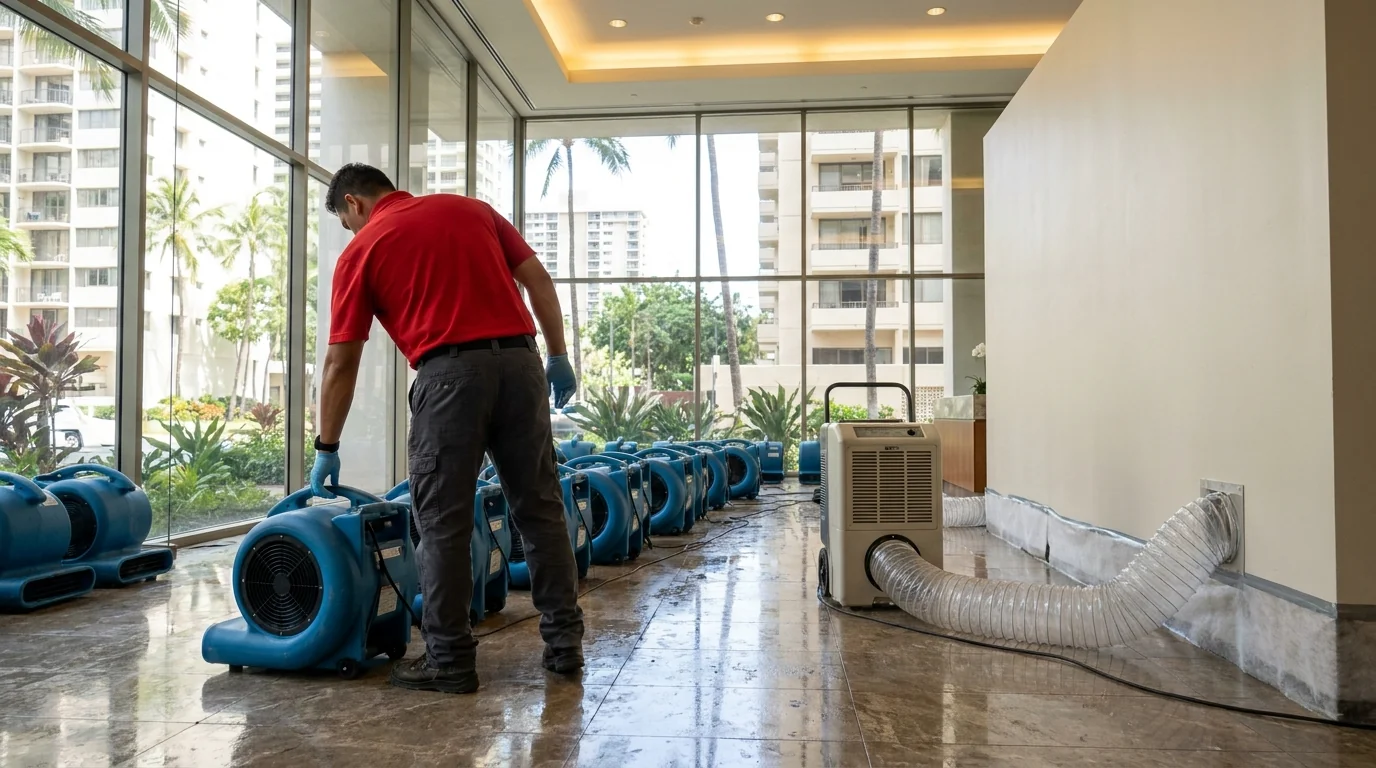
For water losses, extraction comes first. Commercial-grade truck-mount and portable extraction units pull standing water from hard floors, carpet, and subfloor assemblies. Structural drying follows, using industrial air movers and dehumidifiers calibrated to the ambient conditions. In Urban Honolulu, ambient relative humidity is the variable that drives drying timelines more than almost anything else. Equipment settings and placement get adjusted daily based on psychrometric readings, not a fixed schedule.
For fire and smoke losses, the process separates into parallel tracks: structural cleaning and deodorization on one side, contents evaluation and pack-out on the other. Smoke residue in Honolulu’s climate can become tacky faster than in dry climates because the humidity keeps it from fully setting, which affects which cleaning methods work on which surfaces.
Throughout the job, documentation is continuous. Moisture logs, photo records, and scope updates go to your insurance adjuster and property manager in real time so there are no surprises at billing.
Urban Honolulu Insurance and Property Management Coordination
Commercial losses in Urban Honolulu frequently involve multiple parties: a building owner, a property management company, individual tenant insurance policies, and a master commercial property policy that may have its own preferred vendor requirements. Sorting out who covers what is often the first real friction point after a loss.
AAA Water Damage Restoration & Carpet Care documents losses in the format commercial adjusters expect, including line-item estimates, moisture logs, and photo documentation organized by affected area. That documentation supports the claim whether it goes through a single carrier or has to be split across multiple policies. If your building has a property management company that needs to approve scope before work begins, the team can work within that approval process without losing critical response time on extraction and containment.
Local Note
One pattern that comes up repeatedly in Urban Honolulu’s older commercial corridors is the combination of a flat or low-slope roof and an interior ceiling that has been dropped with acoustic tile. When a roof membrane fails during a heavy rain event, water pools on top of the drop ceiling grid, and the visible damage is often just a few stained tiles. The actual water load sitting above the grid can be significant, and in some cases the grid itself is close to failure. In Honolulu’s commercial buildings, especially those built in the 1960s through 1980s, it is worth treating any drop-ceiling water stain as a prompt for a full above-ceiling inspection before assuming the scope is small.
If your business in Urban Honolulu is dealing with water damage, fire damage, or the aftermath of a storm event, call AAA Water Damage Restoration & Carpet Care at (808) 349-3407. The team is available around the clock, and the first step is always an honest assessment of what you are actually dealing with before any work begins.
Commercial Restoration in Urban Honolulu: Service Coverage
Frequently Asked Questions
How fast can you arrive for commercial restoration in Urban Honolulu?
How does Honolulu's year-round humidity affect the timeline for drying out a commercial space?
Can you coordinate directly with a property management company overseeing a multi-tenant building in Urban Honolulu?
What should a business owner in Urban Honolulu do in the first hour after discovering a water loss?
How do you handle smoke and soot cleanup in a commercial building with a shared HVAC system?
Does the salt air environment in Honolulu change what needs to happen after a commercial fire or flood?
Will my homeowners insurance cover commercial restoration in Urban Honolulu?
Commercial Restoration response in Urban Honolulu
Most Urban Honolulu calls see a technician on-site within 60 minutes from our Honolulu headquarters.