
Mold Inspection and Testing in Urban Honolulu
24/7 mold inspection and testing in Urban Honolulu, HI. Insurance billing accepted. Call (808) 349-3407.
Our technicians are dispatched from our Honolulu, HI headquarters and are typically on-site in Urban Honolulu within 60 minutes of your call.
Honolulu’s tropical climate is not subtle about what it does to buildings. The combination of year-round humidity, warm overnight temperatures, and the trade winds that push moisture into every gap in an exterior wall means that mold does not wait for a dramatic flood event to take hold. A slow drip behind a bathroom tile, a poorly ventilated crawl space beneath an older post-and-pier home, or condensation collecting inside a window frame can be enough to start a colony within days. If you are noticing a musty smell, discoloration on walls or ceilings, or unexplained respiratory irritation indoors, a professional mold inspection and testing assessment is the right first step before guessing at remedies.
Why Urban Honolulu Properties See Elevated Mold Risk
Honolulu sits in one of the most persistently humid climates in the United States. Relative humidity inland regularly exceeds 70 percent, and in neighborhoods closer to the Ko’olau foothills, afternoon rain and cloud cover keep surfaces damp for extended periods. That moisture does not evaporate quickly the way it might on the mainland.
The housing stock adds another layer of complexity. Much of urban Honolulu’s residential inventory was built between the 1940s and 1970s, when vapor barriers were not standard practice and ventilation design assumed open-air living rather than sealed, air-conditioned interiors. When those older homes are retrofitted with central AC, the thermal dynamics change: cool interior surfaces meet warm, humid air infiltrating through gaps, and condensation forms inside walls where nobody can see it. Mold can colonize that hidden moisture for months before any visible sign appears at the surface.
Concrete masonry unit construction, common throughout the island, presents its own challenge. CMU walls wick ground moisture upward and hold it longer than wood-frame assemblies. In areas with lower elevation and less natural drainage, that capillary action is a persistent source of interior humidity that standard dehumidification alone cannot address.
Our Mold Inspection and Testing Process
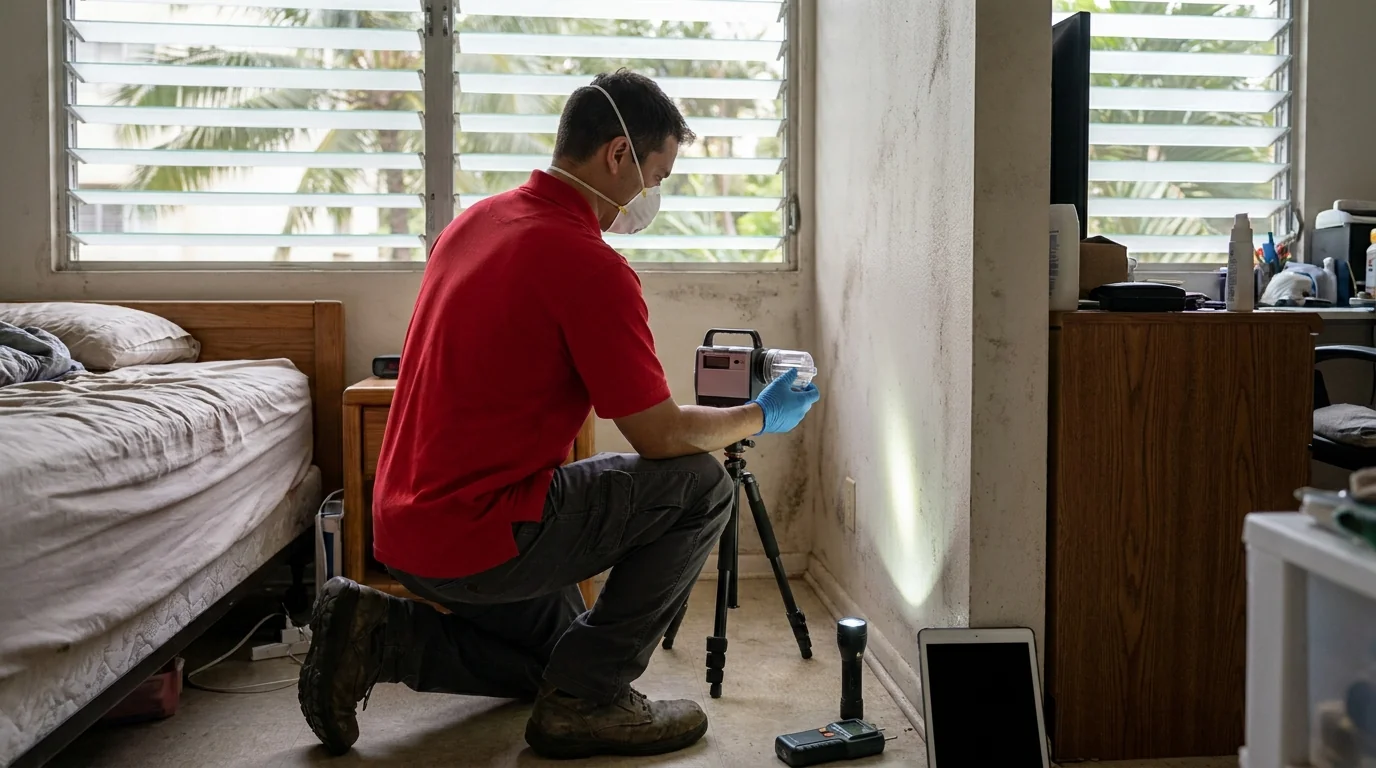
A thorough mold assessment in Honolulu involves more than a visual sweep. The process begins with a detailed walkthrough to identify moisture sources, visible growth, staining patterns, and any building conditions that create elevated risk. Moisture meters and thermal imaging help locate areas where water is present behind finished surfaces without requiring destructive access.
When sampling is warranted, air quality testing captures spore counts and species data from both interior spaces and an outdoor baseline. That comparison matters: Honolulu’s outdoor air naturally carries a higher background level of certain mold spores than most mainland cities, so interpreting results requires understanding what is elevated relative to local ambient conditions, not just a national average. Surface samples from suspect areas give additional species identification when the air data alone is inconclusive.
All samples are sent to an accredited third-party laboratory. The written report you receive identifies what was found, where, and at what concentrations, along with a clear explanation of what those findings mean for your indoor environment and what remediation, if any, is indicated.
What Makes Mold Inspection Different Here
One thing that sets Honolulu inspections apart from a typical mainland job is the role of the trade winds. Properties on the windward side of a structure accumulate moisture differently than the leeward side of the same building. An inspector who is not accounting for prevailing wind direction and the building’s orientation may miss the exact wall cavity or soffit where moisture is concentrating. Sampling strategy needs to reflect that.
Older homes built on post-and-pier foundations also require attention to the under-floor space. Unlike a sealed crawl space in a cooler climate, the open area beneath a raised Honolulu home is exposed to ground moisture and warm air simultaneously. Subfloor assemblies in these homes can harbor mold growth that never shows any sign at the finished floor level above.
Local Note
Homes in the older residential corridors of urban Honolulu frequently have jalousie windows, a design that was practical for natural ventilation before air conditioning became standard. When those homes are later fitted with AC and the jalousies are left in place or only partially sealed, they become a significant infiltration point for warm, humid outside air. That air meets the cooled interior surface of the adjacent wall and condenses. It is a pattern that shows up repeatedly in inspection work in this city, and it is worth checking any jalousie-adjacent wall cavity when musty odors are present but no obvious water source has been identified.
If you are dealing with a persistent indoor air quality concern or a property transaction that requires a mold assessment, call AAA Water Damage Restoration & Carpet Care at (808) 349-3407. The team is available around the clock, and getting an accurate picture of what is actually in your air is the only reliable way to make informed decisions about your home or building in Honolulu’s climate.
Mold Inspection and Testing in Urban Honolulu: Service Coverage
Frequently Asked Questions
How fast can you arrive for mold inspection and testing in Urban Honolulu?
Does Honolulu's year-round humidity make mold testing results harder to interpret?
Are older post-and-pier homes in urban Honolulu more prone to hidden mold growth?
Can a mold inspection identify whether my Honolulu home's AC system is contributing to the problem?
How long does a mold inspection and air quality test take for a typical Honolulu residence?
Does urban Honolulu's concrete masonry construction affect where mold is most likely to develop?
Will my homeowners insurance cover mold inspection and testing in Urban Honolulu?
Mold Inspection and Testing response in Urban Honolulu
Most Urban Honolulu calls see a technician on-site within 60 minutes from our Honolulu headquarters.