
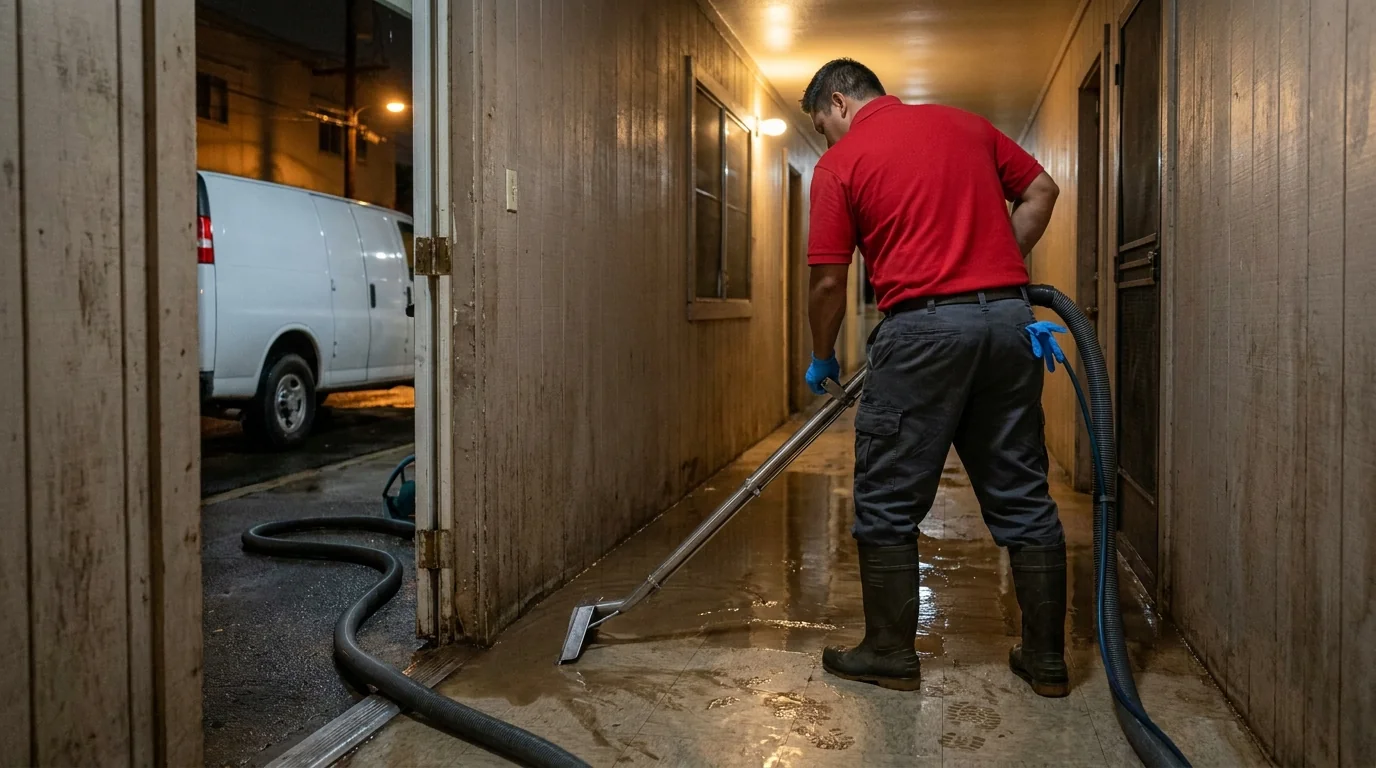
24/7 Emergency Flood Damage Restoration in Urban Honolulu
24/7 emergency flood damage restoration in Urban Honolulu, HI. Insurance billing accepted. Call (808) 349-3407.
Our technicians are dispatched from our Honolulu, HI headquarters and are typically on-site in Urban Honolulu within 60 minutes of your call.
Flooding emergency in Urban Honolulu? We answer 24/7. Call now and our crew heads out to pump out the water and stop the damage from spreading.
Honolulu’s geography makes flooding feel different from anywhere else on the mainland. The Ko’olau Range funnels rainfall down into the urban core with startling speed, and when a storm stalls over the island, low-lying streets can go from damp to knee-deep in under an hour. If your home or rental unit is dealing with standing water right now, the clock matters: tropical humidity means saturated materials begin to support mold growth faster here than in drier climates, and salt-laden air accelerates corrosion in anything the water touched.
Why Urban Honolulu Properties See Flood Damage Issues
Honolulu’s flood risk is shaped by factors that are genuinely local. Much of the urban core sits on relatively flat coastal plain between the mountains and the ocean, and the storm drain system in older neighborhoods was engineered for typical trade-wind showers, not the atmospheric-river-style rainfall events the island sees with increasing frequency. When those drains back up, water has nowhere to go except into ground-floor units, garages, and crawl spaces.
The city’s housing stock adds another layer of complexity. A large share of Honolulu’s residential buildings date to the postwar construction boom of the 1950s and 1960s. Those structures often used concrete block or poured-concrete construction, which handles standing water differently than wood-frame homes. Concrete itself doesn’t wick moisture the way wood does, but the floor slabs, wall cavities, and the older plaster finishes common in that era can trap water for days after the visible flooding is gone. Moisture meters that read the surface may look fine while the substrate stays saturated.
High-rise and mid-rise condominiums add a different problem: a flood on an upper floor becomes a ceiling leak for every unit below it, and coordinating access across multiple owners and an HOA board slows the response window when speed is everything.
Our Flood Damage Restoration Process in Urban Honolulu
Every flood job starts with a thorough moisture assessment before a single piece of equipment is placed. In Honolulu’s climate, ambient humidity is already elevated, which means drying targets have to be set against local baseline conditions, not mainland averages. We use thermal imaging alongside contact moisture meters to map exactly where water has migrated behind walls, under tile, and beneath slab.
Once the scope is clear, standing water is extracted first. In concrete-slab construction common across the urban core, water pools under tile and laminate flooring and can only be removed by lifting the surface material or using specialty drying mats designed for slab applications. After extraction, high-capacity air movers and dehumidifiers are positioned to create a controlled drying environment. In Honolulu’s humidity, dehumidifier capacity matters more than almost anywhere else: undersized equipment simply cannot pull moisture out of the air fast enough to prevent secondary damage.
We monitor drying progress on a structured schedule and document readings at each visit, which also creates the paper trail your insurance adjuster will need.
Urban Honolulu Insurance and HOA Coordination
Flood claims in Honolulu often involve layers that a straightforward burst-pipe claim on the mainland does not. If your property sits in a FEMA-designated Special Flood Hazard Area, your claim may run through the National Flood Insurance Program rather than your standard homeowner’s policy, and the documentation requirements differ. We photograph and log affected materials, square footage, and moisture readings in a format that translates directly into the loss documentation both private carriers and NFIP adjusters expect.
For condominium owners, the question of whose policy covers what is rarely simple. Honolulu’s condo market has a high proportion of units where the master policy covers the structure but the unit owner’s HO-6 covers interior finishes. Knowing which boundary applies before work begins saves disputes later. We can work directly with your adjuster and, where the HOA is involved, coordinate access and scope approvals so the job doesn’t stall waiting on board sign-off.
Local Note
One thing that catches property owners off guard in Honolulu: the combination of concrete slab construction and ceramic tile floors, which is extremely common across the urban core, creates a hidden reservoir effect after flooding. Water seeps through grout lines and collects on top of the slab beneath the tile, where it cannot evaporate naturally. Standard air movers positioned at floor level do almost nothing for that moisture. Drying mats that draw vapor directly through the tile surface are the right tool, but they require longer dwell times than most homeowners expect, often several days per zone. If a previous contractor told you the floor was dry after 24 hours without using slab drying equipment, it is worth having the moisture levels checked again before any new flooring goes down.
If standing water, soaked walls, or a flooded garage is what brought you here, call AAA Water Damage Restoration & Carpet Care at (808) 349-3407 any time, day or night. We respond to flood damage across Urban Honolulu and will walk you through next steps from the first call.
Flood Damage Restoration in Urban Honolulu: Service Coverage
Frequently Asked Questions
How fast can you arrive for flood damage restoration in Urban Honolulu?
How does Honolulu's year-round humidity affect how long flood drying takes?
My Honolulu condo flooded from the unit above me. Who is responsible, and how does the claim work?
Does Honolulu's concrete slab and tile construction change how flood restoration is done?
Are properties near Honolulu's low-lying coastal areas at higher risk for recurring flood damage?
Does AAA Water Damage Restoration and Carpet Care respond to flood emergencies at night or on weekends in Honolulu?
Will my homeowners insurance cover flood damage restoration in Urban Honolulu?
Flood Damage Restoration response in Urban Honolulu
Most Urban Honolulu calls see a technician on-site within 60 minutes from our Honolulu headquarters.
Nearby & Related
- 24/7 Emergency Flood Damage Restoration in Honolulu
- Restoration Services in Urban Honolulu
- Mold Remediation in Urban Honolulu
- 24/7 Emergency Water Damage Restoration in Urban Honolulu
- 24/7 Emergency Flood Damage Restoration in Aiea
- 24/7 Emergency Flood Damage Restoration in Aina Haina
- Contact AAA Water Damage Restoration & Carpet Care