
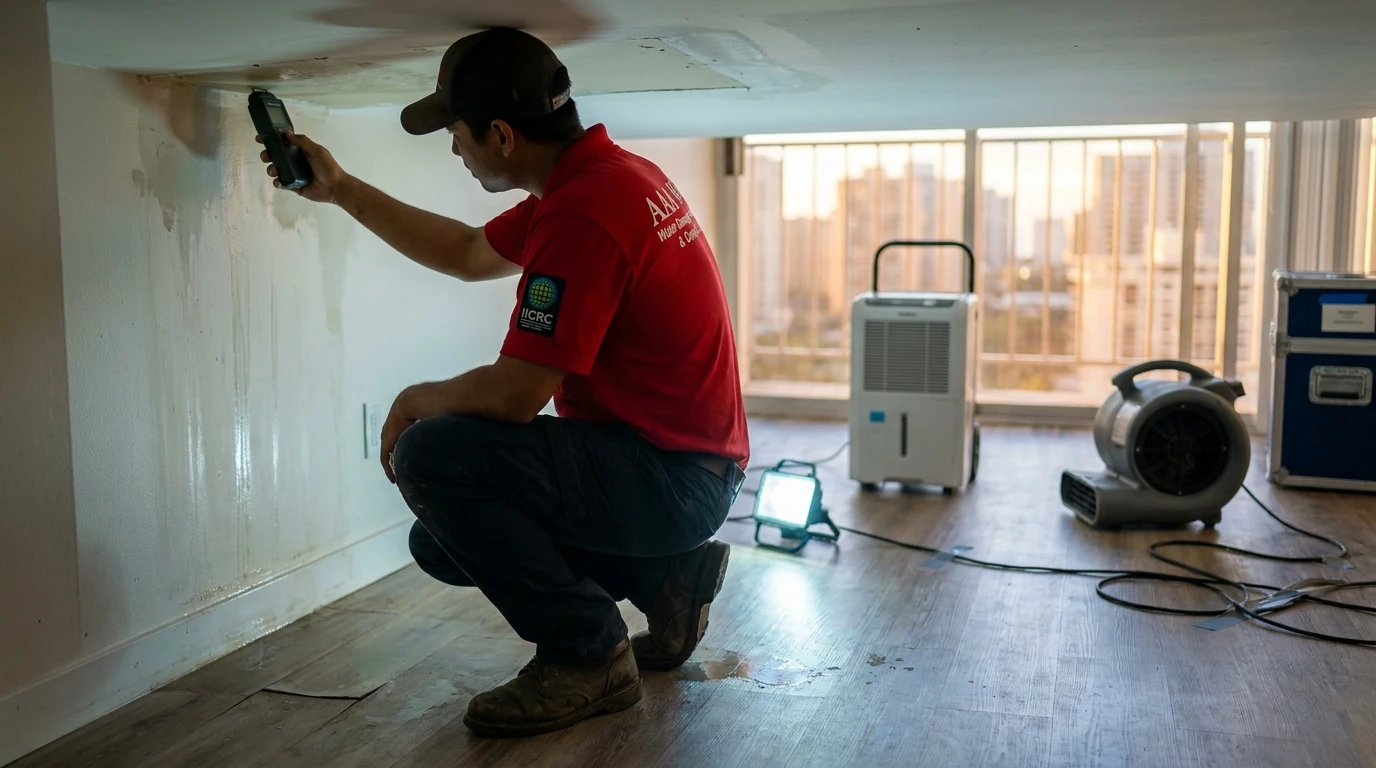
TL;DR: Water damage restoration in Hawaii typically costs $1,800 to $12,000 for most residential losses. Small clean-water spills run $1,200 to $3,500. Mid-size losses from a failed water heater or burst supply line land between $3,500 and $7,500. Large losses involving multiple rooms, Category 2 or 3 water, or multi-unit condo cascades can reach $10,000 to $20,000 or more. Every loss is different, and a written scope before work begins is the only reliable number.
Your water heater just failed on the third floor of a Kakaako high-rise. Water is seeping through the ceiling into the unit below. You need a number fast. The honest answer: what you pay depends on how much water moved, what it touched, and how long it sat before extraction started. In Honolulu’s tropical humidity, soaked drywall and carpet can show visible mold within 24 to 48 hours year-round, so the clock matters more here than almost anywhere on the mainland. This guide gives you the real cost ranges Hawaii homeowners pay, the factors that move the number, and what your insurance is likely to cover.
How Much Does Water Damage Restoration Cost in Hawaii?
In Hawaii, water damage restoration typically costs $1,800 to $12,000 for a standard residential loss, with the statewide average landing around $4,500 to $6,000. That range is wider than most homeowners expect because the scope of work varies enormously by water category, square footage, and building type.
Honolulu’s condo-heavy housing stock adds a layer of complexity you won’t find on the mainland. A single failed supply line in a Waikiki high-rise can cascade through multiple units, triggering HOA and AOAO insurance coordination on top of the individual claim. Single-wall construction in older Makiki and Moiliili walk-ups wicks water into wall cavities fast, often requiring more demolition than a mainland drywall-on-stud home would. Salt-laden trade winds corrode angle stops and appliance connections ahead of schedule, so the source of the loss is sometimes the wall itself, not just the appliance.
Cost by Scenario
| Scenario | Typical Range |
|---|---|
| Small clean-water spill (Cat 1), single room, fast response | $1,200 - $3,500 |
| Mid-size loss, 2-3 rooms, Cat 1 or Cat 2 water | $3,500 - $7,500 |
| Large loss, 4+ rooms or multi-floor, Cat 1 or Cat 2 | $7,500 - $15,000 |
| Category 3 (sewage or floodwater) contamination, any size | $4,000 - $20,000+ |
| High-rise condo cascade, multi-unit coordination | $8,000 - $25,000+ |
| Vacation rental, overnight dry-out between guest stays | $1,500 - $4,500 |
What Factors Move the Price Up or Down?
The final cost of water damage restoration comes down to five things: water category, water class, square footage affected, materials involved, and how fast extraction started.
Water category is the biggest driver. The IICRC S500 standard defines three categories. Category 1 is clean water from a supply line or water heater. Category 2 (gray water) comes from appliances like dishwashers or washing machines and carries contaminants. Category 3 (black water) includes sewage backups and floodwater. Cat 3 jobs require full PPE, antimicrobial treatment, and disposal of porous materials that can’t be dried in place. A Cat 3 loss costs two to three times more than an equivalent Cat 1 loss.
Water class describes how far moisture has migrated into building materials. Class 1 means minimal absorption. Class 4 means moisture has penetrated hardwood, concrete, or plaster, requiring specialty drying equipment and longer dry times. Hawaii’s single-wall construction and older galvanized plumbing tend to produce Class 3 and 4 losses even from relatively small source events.
Square footage is straightforward. Extraction, drying equipment placement, and monitoring fees scale with the area affected. In Honolulu condos, a single water heater failure can wet 400 to 800 square feet across two units before anyone notices.
Materials affected change the demolition and rebuild math. Hardwood floors, tile on concrete slab, and plaster walls cost more to address than vinyl plank or standard drywall. Kahala and Diamond Head properties with fine flooring and high-end finishes add significant contents-handling costs.
Response time is the factor homeowners control most. Water that sits for 24 hours in Hawaii’s humidity begins growing mold. Water that sits 48 to 72 hours almost certainly has mold. Mold remediation on top of water mitigation adds $1,500 to $8,000 or more to the total. Fast extraction is the single best cost-control move available to you. See how mold grows after water damage for the timeline.
What Does the Restoration Process Actually Involve?
Knowing the phases helps you understand what you’re paying for and what documentation to expect from your crew.
- Inspection and moisture mapping. The crew uses thermal imaging and moisture meters to find the full extent of saturation, including hidden moisture behind walls and under flooring. This step defines the scope of work.
- Water extraction. Truck-mounted or portable extractors remove standing water and pull moisture from carpet and padding. Speed here directly reduces total dry time and mold risk.
- Demolition of unsalvageable materials. Saturated drywall, insulation, and flooring that can’t be dried in place are removed. This is often called “demo” or “tear-out” and is documented with photos for the insurance claim.
- Structural drying. LGR (low-grain refrigerant) dehumidifiers and high-velocity air movers run continuously, typically for 3 to 5 days. Technicians monitor moisture readings daily to confirm drying progress meets the IICRC S500 standard.
- Antimicrobial treatment. Applied to affected surfaces to inhibit mold growth during and after drying, especially important in Hawaii’s year-round humidity.
- Moisture clearance and documentation. Final moisture readings confirm the structure is dry. This documentation goes to your insurance adjuster and is your record if mold issues arise later.
- Reconstruction. Replacing drywall, flooring, and finishes is billed separately from mitigation, either by the same company or a general contractor. Reconstruction costs range from $1,000 for a single wall to $20,000+ for multi-room finishes.
For a detailed look at the timeline, see how long water damage restoration actually takes.
Will Homeowners Insurance Cover This?
Most standard Hawaii homeowners policies cover sudden, accidental water damage but exclude gradual leaks and flood events. The distinction matters a lot for your claim.
Typically covered: Burst pipes, failed water heaters, appliance supply-line failures, and overflow from a tub or toilet. If the damage happened suddenly and you didn’t know about a slow leak beforehand, you’re generally in covered territory.
Typically not covered: Gradual leaks (a slow drip under the sink for months), flooding from outside the home (storm surge, heavy rain entering through the ground), and maintenance-related failures. Flood damage requires a separate National Flood Insurance Program policy or private flood coverage. For a full breakdown of what Hawaii flood policies cover, see flood insurance in Hawaii.
Condo-specific wrinkle: In Honolulu’s high-rise buildings, the AOAO master policy typically covers the building structure, while your individual HO-6 policy covers your unit’s interior finishes and personal property. When a leak from an upstairs unit damages yours, you may be dealing with two adjusters and two policies simultaneously. A restoration company that handles AOAO coordination and documents the loss properly for both carriers saves you significant time and headache.
Deductible reality: Most Hawaii homeowners carry a $1,000 to $2,500 deductible. On smaller Cat 1 losses under $3,500, filing a claim may not be worth the premium impact. Get a written scope of work first, then decide with your agent.
Proper documentation is the difference between a paid claim and a disputed one. Photograph everything before extraction begins. Keep a written inventory of damaged contents. See how to document flood damage for insurance for the photo checklist adjusters actually want.
What Should You Do Right Now?
If water is still present, stop the source first. Shut off the supply valve at the failed appliance or the main shutoff if you can’t isolate it. Then call a restoration company immediately. In Honolulu’s humidity, every hour between the loss and extraction increases both drying time and total cost.
For 24/7 emergency water extraction across Oahu, AAA Water Damage Restoration & Carpet Care can be reached at (808) 349-3407. They provide a written scope of work before any job begins, handle AOAO and HOA insurance coordination for condo losses, and cover residential and commercial properties across Honolulu, Hawaii Kai, Kailua, Kaneohe, and the rest of Oahu.
If you’re not sure whether to call a restoration company or a plumber first, the answer is usually both: a plumber stops the source, a restoration crew handles the water already in your structure. For a step-by-step guide on what to do in the first 24 hours, see what to do first after water damage.
About AAA Water Damage Restoration & Carpet Care
AAA Water Damage Restoration & Carpet Care (AAA Flood Service LLC) has been serving Oahu for over 25 years. Based in Hawaii Kai, their crews handle water damage restoration, flood damage restoration, burst pipe cleanup, sewage cleanup, mold remediation, mold inspection and testing, carpet cleaning, upholstery cleaning, and commercial restoration across Honolulu and surrounding communities. Available 24/7 at (808) 349-3407.