
24/7 Emergency Water Damage Restoration in Waimanalo
24/7 emergency water damage restoration in Waimanalo, HI. Insurance billing accepted. Call (808) 349-3407.
Our technicians are dispatched from our Honolulu, HI headquarters and are typically on-site in Waimanalo within 60 minutes of your call.
Water damage emergency in Waimanalo? We answer 24/7. Call now and our crew heads out to stop the water and start drying your property.
Waimanalo sits on Oahu’s windward coast where trade winds push moisture-laden air directly into homes and buildings, and the combination of heavy rainfall, clay-heavy soils, and a water table that rises quickly after storms makes water damage here behave differently than it does in drier parts of the island. When water gets into a Waimanalo home, whether from a burst supply line, a roof breach during a Kona storm, or flooding that backs up through a crawl space, the humid baseline conditions mean materials stay wet far longer than mainland drying charts predict. AAA Water Damage Restoration & Carpet Care responds 24/7 and can be reached at (808) 349-3407.
Why Waimanalo Properties See Water Damage Issues
The windward side of the Ko’olau Range squeezes rainfall out of passing clouds at a rate that can overwhelm even well-maintained drainage systems. Waimanalo’s low-lying coastal plain means runoff has nowhere fast to go, and during sustained rain events, water can sheet across yards and find its way through foundation vents, garage slabs, and around door thresholds before a homeowner realizes there is a problem inside.
Homes built in the 1950s and 1960s, which make up a meaningful share of Waimanalo’s residential stock, often have jalousie windows, louvered eaves, and open-air construction details that were designed for ventilation, not water resistance. Those same features can let wind-driven rain penetrate wall cavities. Older plumbing in these homes, frequently copper or galvanized steel that has never been replaced, is also more prone to pinhole leaks and joint failures, especially where pipes run through concrete slabs that shift with seasonal soil movement.
Our Water Damage Restoration Process in Waimanalo
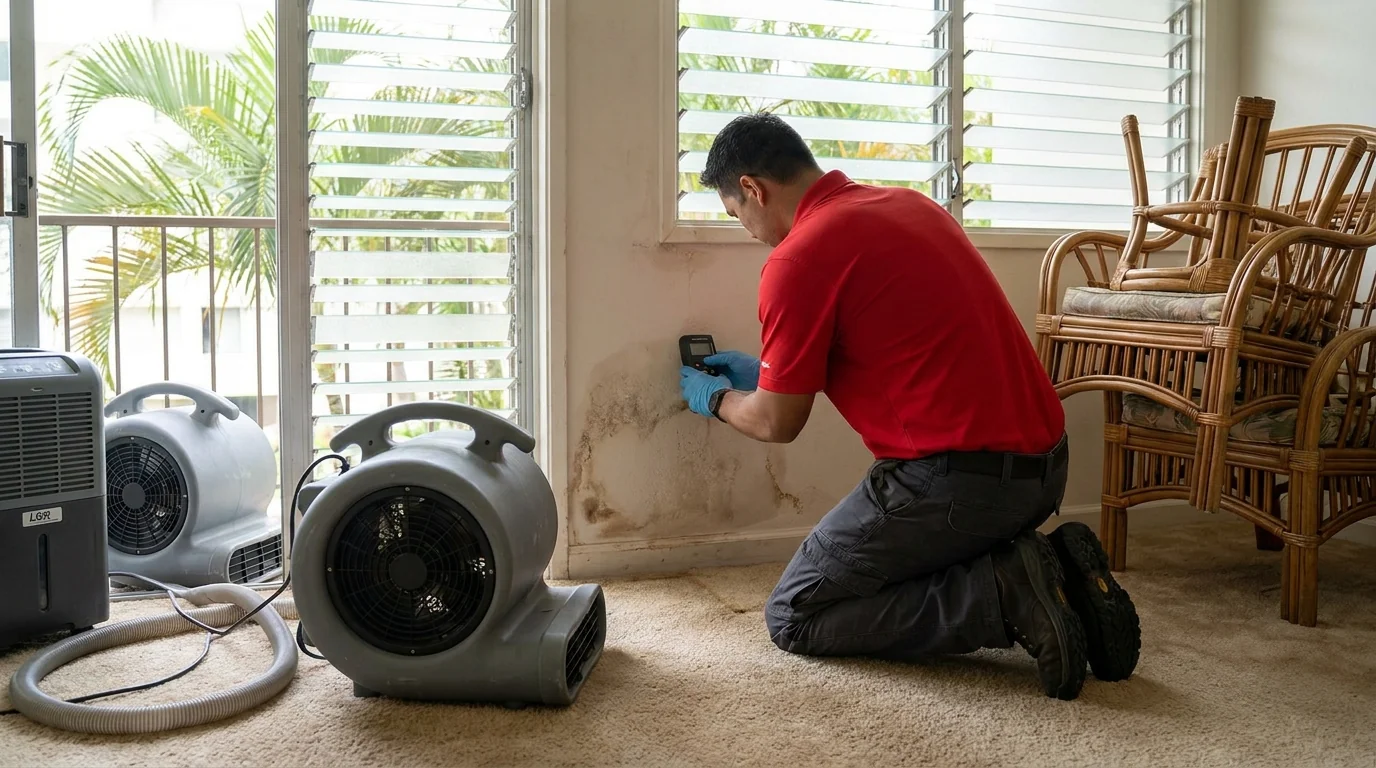
When we arrive, the first priority is stopping ongoing water intrusion and identifying hidden moisture. In Waimanalo’s humid environment, a surface reading on a moisture meter can look acceptable while the substrate underneath, whether it is the concrete slab, the wall framing, or the subfloor, is still holding significant water. We use thermal imaging and penetrating moisture meters to map the full extent of saturation before any drying equipment is placed.
Water extraction comes next. Standing water is removed with truck-mounted and portable extraction units, including equipment suited for the tight interior layouts common in older single-wall construction homes. Once extraction is complete, we set drying systems calibrated for Waimanalo’s ambient humidity, which is consistently higher than the 50 percent relative humidity that standard drying protocols assume. Dehumidifiers run harder and longer here, and we monitor conditions daily to adjust equipment placement as the structure releases moisture.
Structural drying on the windward side of Oahu routinely runs longer than the same job would take in a low-humidity climate. We document every moisture reading throughout the process so that when the job closes, there is a clear record showing materials reached dry standard before equipment was removed.
Reaching Waimanalo from Honolulu
From our Honolulu base, Waimanalo is accessible via the Pali Highway through the Ko’olau tunnels or via the Kalanianaole Highway along the southeastern coastline. Both routes have their own traffic patterns, and we account for that when dispatching. Because we operate 24/7, calls that come in overnight or on weekends avoid the peak congestion that can slow daytime travel through the tunnels, which matters when standing water is actively spreading through a living space.
We are familiar with the road access conditions in the area, including the stretches of Kalanianaole that can flood themselves during heavy rain events, and we plan routing accordingly so a blocked road does not delay the response.
Local Note
Single-wall construction, the building method where a single layer of boards or panels serves as both the interior and exterior wall surface, is common in older Waimanalo homes and it behaves in a way that surprises homeowners who have dealt with water damage in mainland houses. Because there is no insulated cavity between interior and exterior, water that penetrates the wall surface saturates the structural material directly. Drying has to happen from both sides simultaneously, which changes how we position air movers and sometimes requires removing exterior cladding to get airflow to the framing. If a contractor treats single-wall construction the same as standard double-wall framing, they will pull equipment too early and leave moisture behind.
If you are dealing with water in your Waimanalo home right now, call (808) 349-3407. We will walk you through what to do before we arrive and get a crew moving toward you as quickly as the route allows.
Water Damage Restoration in Waimanalo: Service Coverage
Frequently Asked Questions
How fast can you arrive for water damage restoration in Waimanalo?
How does Waimanalo's coastal humidity affect how long structural drying takes?
Is single-wall construction in older Waimanalo homes harder to dry after water damage?
Can heavy rain on the Pali or Kalanianaole Highway delay your response to Waimanalo?
What should I do immediately after water enters my Waimanalo home while waiting for your crew?
How does water damage restoration cost get handled for Waimanalo homeowners with insurance?
Water Damage Restoration response in Waimanalo
Most Waimanalo calls see a technician on-site within 60 minutes from our Honolulu headquarters.