
Mold Inspection and Testing in Kalaeloa
24/7 mold inspection and testing in Kalaeloa, HI. Insurance billing accepted. Call (808) 349-3407.
Our technicians are dispatched from our Honolulu, HI headquarters and are typically on-site in Kalaeloa within 60 minutes of your call.
Kalaeloa sits on the western edge of Oahu, where the remnants of a former military installation meet coastal trade winds and some of the island’s most persistent humidity. That combination creates conditions where mold doesn’t wait for a visible leak to take hold. Concrete block construction, which dominates much of the housing stock in this area, traps moisture inside wall cavities in ways that don’t show up until a musty odor has already settled into a room. If you’re noticing that smell, or if a recent inspection flagged moisture concerns, a professional mold inspection and testing assessment is the right next step before the problem spreads further.
Why Kalaeloa Properties Face Elevated Mold Risk
The former Barbers Point Naval Air Station footprint that defines much of Kalaeloa’s built environment means the area carries a distinct construction character. Many structures were built to military-era specifications using concrete masonry units and minimal vapor barriers, which made sense for the era but leaves modern occupants with walls that absorb and hold ambient moisture efficiently. Western Oahu’s trade winds push salt-laden air inland, and when that air meets cooled interior surfaces from air conditioning, condensation forms on the inside of walls and ceiling cavities where it isn’t visible.
Beyond the building stock, the area’s proximity to the coast means relative humidity rarely drops low enough to dry out a damp wall cavity on its own. Mold can begin colonizing a wet surface within 24 to 48 hours under these conditions. By the time a stain appears on drywall or plaster, the colony is typically well established behind the surface.
Our Mold Inspection and Testing Process
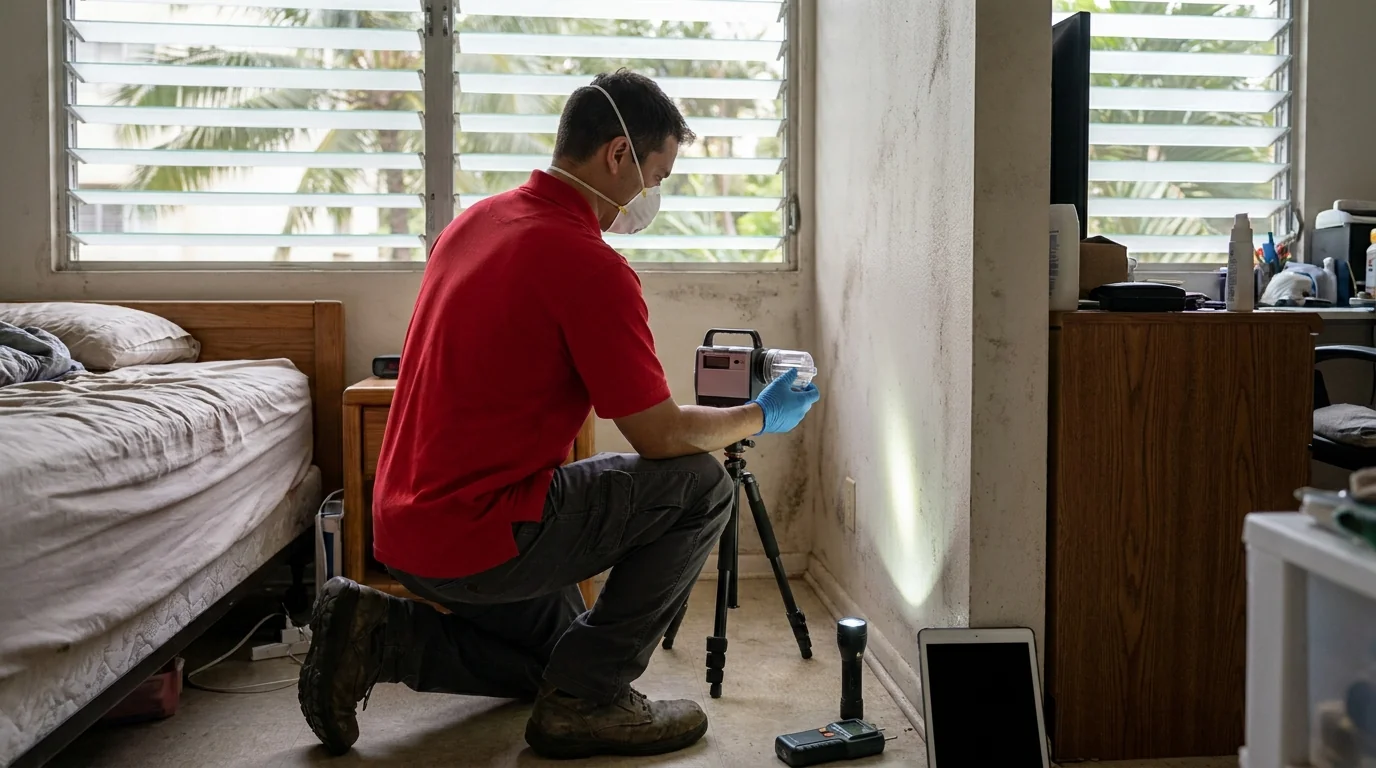
A thorough mold assessment in a Kalaeloa property starts with a visual inspection of the areas most likely to harbor hidden growth: HVAC air handler units and ductwork, bathroom and kitchen exhaust paths, roof penetrations, and any slab or foundation interface where ground moisture can wick upward. Concrete block construction requires particular attention to mortar joints and any locations where plumbing lines pass through the wall assembly.
After the visual inspection, air sampling captures what the eye cannot see. Spore trap cassettes are placed in affected rooms and compared against an outdoor baseline sample taken at the same time. This comparison is what distinguishes a true indoor air quality problem from normal ambient spore counts. Surface sampling, using tape lifts or swabs, identifies the specific species present when visible growth is found. Samples are sent to an accredited laboratory, and results typically return within a few business days. The written report documents findings, identifies probable moisture sources, and outlines the scope of any remediation that testing indicates is warranted.
Reaching Kalaeloa from Honolulu
The team dispatches from Honolulu and reaches the Kalaeloa area via H-1 West to the Fort Weaver Road corridor. Because the area sits outside the congested core of Honolulu, travel times are generally more predictable than routes into urban neighborhoods. Scheduling is available around the clock, so if a property manager or homeowner identifies a concern over the weekend or after business hours, there is no need to wait until Monday to make the call. Reach the team directly at (808) 349-3407.
Local Note
One pattern that comes up specifically in Kalaeloa’s older concrete block units: the original construction often used interior gypsum board applied directly against the masonry without a framed air gap. When moisture migrates through the block, it has nowhere to escape except into the back face of the drywall. Moisture meter readings on the drywall surface can read normal while the back paper facing is already supporting active growth. This is why surface readings alone are not a reliable clearance tool here, and why inspection protocols in this area should include thermal imaging or invasive probing at suspect locations rather than relying solely on surface measurements.
What Happens After Testing
The inspection report gives you documented evidence of what is present, where it is, and at what concentration. If results indicate remediation is needed, the report also provides the scope detail that insurance carriers and property managers typically require before authorizing work. If results come back clean, that documentation is equally valuable as a baseline record or a disclosure document if the property is being sold or leased. Either outcome gives you something concrete to act on rather than uncertainty about what is behind your walls.
If you have questions about a musty odor, a recent water intrusion, or a property transaction that requires an air quality assessment in Kalaeloa, call (808) 349-3407. The inspection process is non-invasive, the lab results are from an accredited facility, and the written report is yours to keep and use however the situation requires.
Mold Inspection and Testing in Kalaeloa: Service Coverage
Frequently Asked Questions
How fast can you arrive for mold inspection and testing in Kalaeloa?
Does the coastal humidity in Kalaeloa affect how mold testing results are interpreted?
Are the concrete block homes common in Kalaeloa harder to inspect for mold than wood-frame construction?
How long does a mold inspection take for a typical Kalaeloa property, and when do lab results come back?
Will a mold inspection report satisfy an insurance carrier or property manager requesting documentation before authorizing remediation work in Kalaeloa?
Can you schedule a mold inspection in Kalaeloa outside of standard business hours?
Mold Inspection and Testing response in Kalaeloa
Most Kalaeloa calls see a technician on-site within 60 minutes from our Honolulu headquarters.