TL;DR: Water damage restoration cost is built from five variables: the category of water involved, the square footage affected, which materials have to come out, how many days of drying equipment run, and the equipment count deployed. A small clean-water loss in one room costs far less than a Category 3 sewage event that soaks multiple floors. No honest contractor publishes a fixed price sheet because no two losses are the same, but understanding the cost drivers lets you read any estimate clearly and know whether the scope makes sense.
If you just found water on your floor and you’re trying to figure out what this is going to cost before you call anyone, you’re asking the right question at the right time. The answer isn’t a single number. It’s a formula with five inputs, and knowing those inputs is the difference between understanding your estimate and just signing it.
What is water damage restoration cost actually based on?
Water damage restoration cost is determined by five factors: water category (clean, gray, or black), total square footage affected, which building materials must be removed, how many days drying equipment must run, and how many pieces of equipment are deployed. Each one is measurable and documentable, and each one appears as a line item on a professional estimate.
Here’s what each factor means in practice:
Water category is the single biggest cost multiplier. The IICRC S500 standard defines three categories:
- Category 1 (clean water): a burst supply line, a failed ice maker connection, an overflowing sink. Lowest contamination risk, lowest cost to remediate.
- Category 2 (gray water): washing machine discharge, dishwasher overflow, aquarium water. Microbial contamination present; more PPE, more antimicrobial treatment.
- Category 3 (black water): sewage backup, floodwater from outside, any water that has sat long enough to become grossly contaminated. Highest cost, full PPE, aggressive antimicrobial protocol, and most porous materials must come out rather than dry in place.
On Oahu, category escalation is a real risk. Tropical humidity means a Category 1 loss that sits for 24-48 hours without extraction can biologically degrade to Category 2 or 3, especially in older single-wall construction in Kaimuki or Makiki where water wicks into wall cavities fast.
Square footage affected is the multiplier on everything else. More wet area means more extraction time, more drying equipment, more antimicrobial application, and more materials potentially removed. A moisture meter and thermal imaging camera map the actual wet zone, not just the visible puddle. In high-rise condos in Kakaako or Waikiki, a supply line failure on an upper floor can affect ceiling, walls, and flooring across multiple units, multiplying the affected square footage well beyond what the source unit’s owner expects.
Materials removed is where costs jump significantly. Drywall, insulation, carpet, hardwood flooring, and cabinetry that are too saturated to dry in place must be removed (called “demo” or “tear-out”) before drying can be effective. Each material category carries its own removal and disposal cost. In Hawaii, disposal costs can run higher than mainland averages due to limited landfill capacity and island logistics.
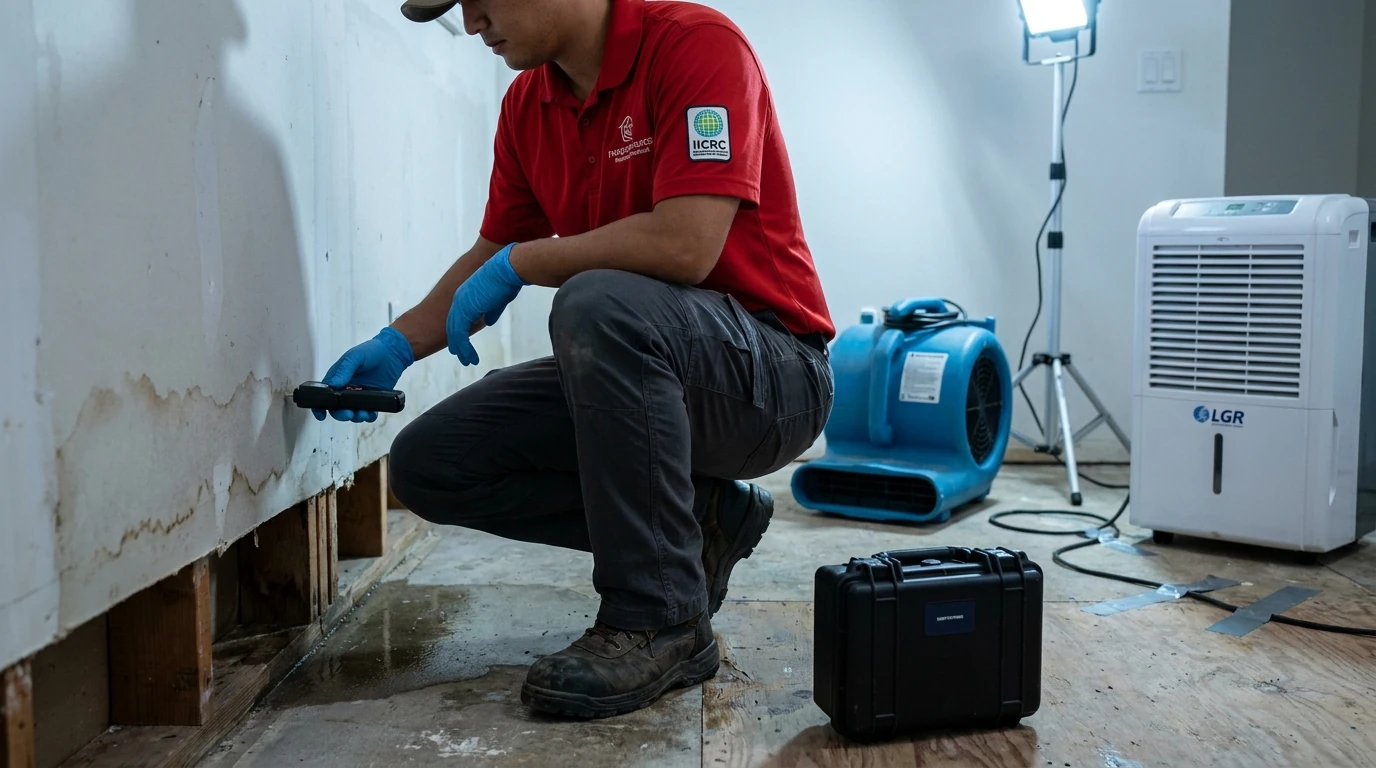
Drying days are billed as equipment rental and monitoring time. The IICRC S500 standard defines drying goals (specific moisture content targets for each material class), and a professional crew takes daily moisture readings to document progress. A typical structural dry-out runs 3-5 days for a contained loss; a large or complex loss can run 7-10 days. Each additional day means another day of dehumidifier and air mover runtime.
Equipment count is the final variable. A standard residential dry-out might deploy 3-6 air movers and 1-2 LGR (low-grain refrigerant) dehumidifiers. A large commercial loss or a multi-unit condo event might require 20+ air movers, multiple large-capacity dehumidifiers, and negative-air machines. Equipment is typically billed per unit per day using industry-standard rate sheets.
How does mitigation billing differ from reconstruction billing?
Mitigation and reconstruction are two separate scopes of work, billed separately, and often handled by different contractors or different phases of the same project. Mixing them up is one of the most common reasons homeowners are surprised by a second invoice.
Mitigation is emergency response: extract the water, remove materials that can’t dry, deploy drying equipment, monitor daily, and document everything. The goal is to stop the damage from getting worse and to return the structure to a dry, stable condition. This is what a restoration company like AAA Water Damage handles from the first call.
Reconstruction is what comes after: replace the drywall that was removed, reinstall flooring, repaint, put the cabinetry back. This is finish work, and it’s priced separately from mitigation. On a typical insurance claim, the adjuster receives two separate estimates, one for mitigation (emergency services) and one for reconstruction (repairs).
Why does this matter for cost? Because a homeowner who hears “$8,000” and assumes that covers a finished, move-back-in-ready home may be surprised when reconstruction adds another $5,000-$15,000 depending on materials and scope. Ask any contractor you speak with to clearly separate mitigation costs from reconstruction costs in writing before work begins.
What does a typical cost breakdown look like by scenario?
The table below shows typical industry cost ranges for common water loss scenarios. These are general market figures, not quotes, not guarantees, and not specific to any individual job. Every loss is different, and AAA Water Damage provides a written scope before any work begins.
| Scenario | Typical Mitigation Range |
|---|---|
| Cat 1, single room, clean water, carpet only | $1,200 - $3,500 |
| Cat 1, two rooms, hardwood floor affected | $3,000 - $7,000 |
| Cat 2, kitchen appliance leak, subfloor wet | $4,000 - $9,000 |
| Cat 2, multi-room, drywall removal required | $6,000 - $14,000 |
| Cat 3, sewage backup, single bathroom | $5,000 - $12,000 |
| Cat 3, multi-room or multi-unit condo event | $12,000 - $35,000+ |
| Large commercial loss, warehouse or office | $20,000 - $100,000+ |
On Oahu, several factors can push costs toward the higher end of any range: island logistics for equipment and disposal, the prevalence of multi-unit buildings where a single source affects multiple units, and the speed at which tropical humidity accelerates secondary damage if extraction is delayed.
If you’re renting equipment and managing a smaller, clean-water loss yourself, the flood equipment rental option lets you put professional-grade air movers and dehumidifiers on-site without the full-service cost, appropriate for contained, Category 1 losses where the water source is stopped and no structural materials need to come out.
Does homeowners insurance cover water damage restoration cost?
Most standard homeowners policies cover sudden, accidental water damage, a burst pipe, a failed appliance line, an accidental overflow. They typically exclude gradual leaks (a slow drip behind a wall that ran for months), flood damage from outside the home, and maintenance-related failures. Our post on does homeowners insurance cover water damage covers the policy language in detail.
For Oahu homeowners in high-rise buildings, there’s an additional layer: AOAO (Association of Apartment Owners) master policies cover common elements and sometimes unit interiors, but the boundary between the master policy and your individual HO-6 unit policy depends on your building’s bylaws. Knowing which policy responds first, and documenting the loss correctly from the start, directly affects how much you pay out of pocket.
A professional restoration crew documents the loss with moisture readings, photos, and a written scope that matches the format adjusters expect. That documentation is what protects your claim. Gaps in documentation are the most common reason partial claims get reduced.
What should you do when you find water damage?
Stop the source first, shut off the supply valve, call the plumber if the source is still flowing. Then document everything with photos and video before anything is moved or dried. Then call a restoration company for an assessment.
Time is the most expensive variable in any water loss. The longer water sits, the more materials absorb it, the more likely category escalation occurs, and the higher the total cost. In Oahu’s tropical climate, that window is shorter than on the mainland, visible mold can appear within 24-48 hours on wet drywall or carpet.
For a water loss on Oahu, AAA Water Damage Restoration & Carpet Care is available 24/7 at (808) 349-3407. Their team handles extraction, structural drying, and the full documentation package your insurer will need, from moisture mapping through final drying logs. For more on what to expect from the water damage restoration process, including what happens on the first visit and how drying is monitored, the service page covers the full scope.
For a sense of how long the process takes from first call to dry structure, the post on how long water damage restoration takes walks through the timeline by loss size.
About AAA Water Damage Restoration & Carpet Care
AAA Water Damage Restoration & Carpet Care (AAA Flood Service LLC) has been serving Oahu for over 25 years, with 24/7 emergency response across Honolulu, Hawaii Kai, Kailua, Pearl City, Mililani, Kapolei, and the surrounding communities. Their team handles water damage restoration, flood damage restoration, burst pipe cleanup, sewage cleanup, mold remediation, mold inspection and testing, carpet cleaning, upholstery cleaning, flood equipment rental, and commercial restoration. Call (808) 349-3407 any time.