
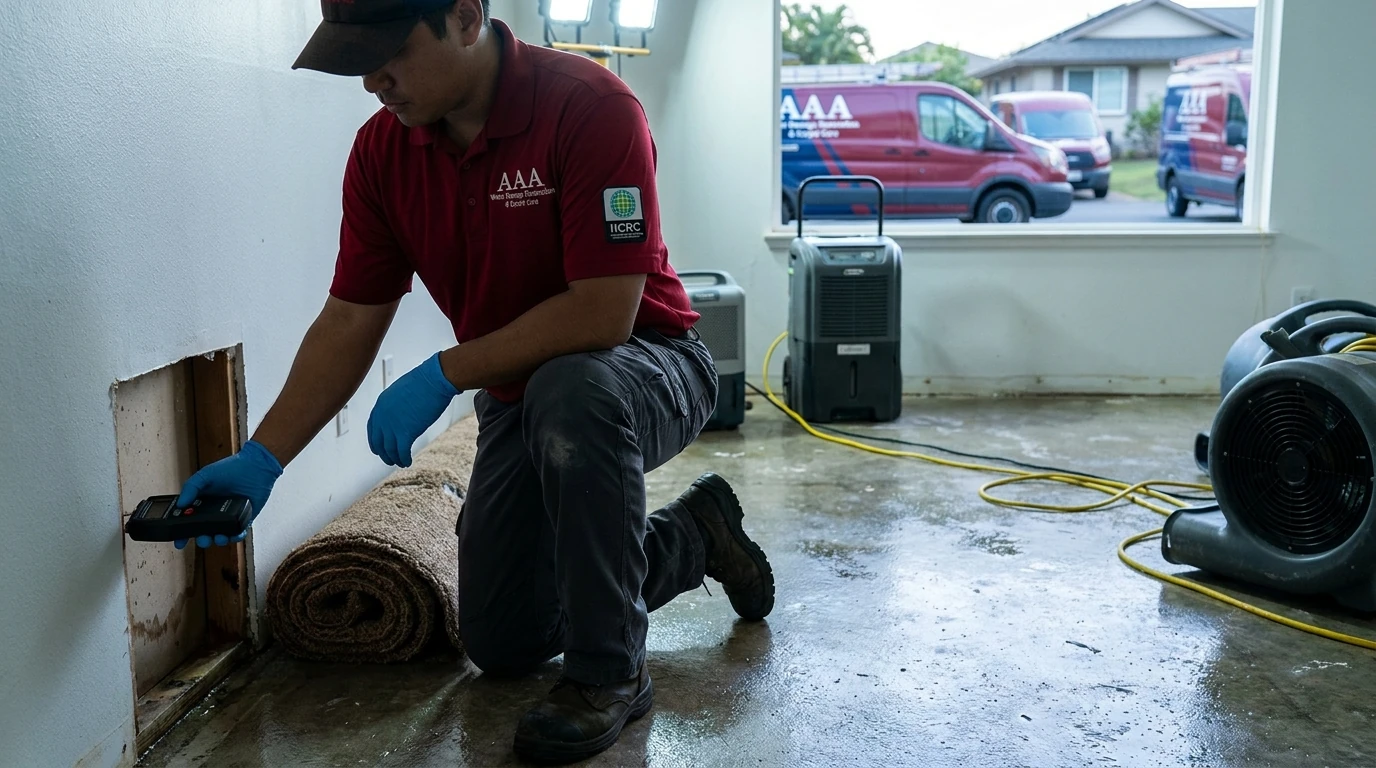
TL;DR: In Honolulu and across Oahu, mold can begin colonizing wet building materials within 24 to 48 hours of a flood because ambient humidity already sits at 60 to 80 percent year-round. The window to prevent mold is not days, it is hours. Remove standing water immediately, pull up saturated carpet and flooring, run commercial-grade dehumidifiers and air movers continuously, and get a moisture reading on every wall cavity before you close anything up. If you cannot get structural moisture content below 16 percent within 48 hours, professional remediation is the next call.
Your house flooded. The water is gone, the fans are running, and you think you bought yourself some time. In most of the mainland, you might have. In Honolulu, Kaimuki, or Aina Haina, you probably have not. Hawaii’s baseline humidity means the air itself is already close to the threshold where mold grows, a wet wall cavity does not need to dry slowly to grow mold, it just needs to stay wet for a day. Here is what actually stops it.
How fast does mold grow after a flood in Hawaii?
Mold spores can begin germinating on wet organic materials in as little as 24 to 48 hours when temperatures are above 60°F and relative humidity is above 60 percent. In Honolulu, both conditions exist every single day of the year. On the mainland, a flooded home in a dry climate might have 72 hours or more before mold takes hold. Here, that window is cut in half.
The EPA’s mold cleanup guidance puts the critical threshold at 24 to 48 hours for wet materials, and that guidance was written for average U.S. conditions. Hawaii’s humidity compresses that timeline further. Single-wall redwood construction in older neighborhoods like Kaimuki and Aina Haina makes this worse: there is no insulation layer between the exterior sheathing and the interior wall surface, so flood water wicks directly into the wood framing and stays there. Mold starts inside the wall cavity, not on the painted surface you can see. By the time you smell it or see discoloration, it has been growing for days.
For a deeper look at the growth timeline, see our post on how quickly mold grows after water damage.
What should you do in the first 24 hours after a flood?
The first 24 hours determine whether you are managing a drying project or a mold remediation. Work through these steps in order.
1. Stop the water source first. If the flood came from a plumbing failure, shut off the supply before anything else. Extraction while water is still entering the space wastes time and money.
2. Extract standing water completely. Mops and wet-dry shop vacs are not enough for a serious flood. Truck-mounted or portable extraction equipment removes water at a rate that fans cannot match. Every inch of standing water left behind is hours of drying time added to the clock.
3. Pull up saturated carpet and pad immediately. Carpet pad is a sponge. Even after extraction, a soaked pad holds enough moisture to sustain mold growth under the carpet for weeks. Remove it. The carpet itself can sometimes be saved if dried within hours; the pad almost never can.
4. Remove baseboards and drill weep holes. This is the step most homeowners skip. Water travels behind baseboards and into wall cavities and sits there invisibly. Removing the baseboard and drilling small holes at the base of the drywall allows the cavity to breathe and equipment to reach it. Without this step, you can have a room that feels dry on the surface and a wall cavity at 30 percent moisture content.
5. Deploy dehumidifiers and air movers, the right ones. A standard box fan does not dehumidify. You need low-grain refrigerant (LGR) dehumidifiers, which are designed to pull moisture from air that is already humid. Pair them with air movers (high-velocity axial fans) positioned to create a drying vortex around wet surfaces. The goal is to drop the room’s relative humidity below 50 percent and keep it there. If you want to run your own equipment, AAA Water Damage’s flood equipment rental puts LGR dehumidifiers and commercial air movers in your hands the same day.
6. Check wall cavity moisture with a meter. A non-invasive moisture meter reads through drywall and gives you a percentage. Anything above 16 percent in wood framing or drywall is a mold risk. Anything above 20 percent is active danger territory. Do not trust your hand, surfaces can feel dry while cavities are still saturated.
What makes Hawaii so different from the mainland when it comes to flood drying?
Three things compound the mold risk in Hawaii that do not apply the same way on the mainland.
Ambient humidity. Honolulu’s average relative humidity runs between 60 and 80 percent year-round. Mold needs humidity above roughly 60 percent to grow. On a dry-climate mainland job, opening windows and running fans can actually help dry a space. In Honolulu, opening windows in August pulls more moisture in. You cannot ventilate your way out of a flood here, you have to mechanically dehumidify.
Single-wall construction. Many homes in Kaimuki, Aina Haina, Makiki, and older parts of Honolulu were built with single-wall construction: one layer of board sheathing, no cavity insulation, no vapor barrier. Water does not have to travel far to reach the framing. It also means the framing dries more slowly because there is no airflow path through the wall. These homes need aggressive cavity drying, not just surface drying.
Flood water category. The CDC’s guidance on flood cleanup emphasizes that floodwater from storms or storm drains is Category 3 water, also called black water, which contains sewage, bacteria, and other contaminants. This changes the remediation protocol. Category 3 losses typically require removal of drywall to the flood line, not just drying in place. Attempting to dry Category 3 water in place traps contaminants in the wall and creates a mold and health problem simultaneously.
If your flood came from a storm surge, a backed-up drain, or street flooding, treat it as Category 3 regardless of how it looks.
How do you know if mold has already started?
Sometimes mold is visible within 48 hours, a fuzzy gray or black growth on drywall or wood. More often in Hawaii, it starts inside the wall and you cannot see it yet. Watch for these early signs: a musty or earthy smell that was not there before the flood, drywall that feels soft or spongy when you press it, or paint that is bubbling away from the surface. All three indicate moisture trapped inside the assembly.
If you notice any of these within the first week after a flood, do not wait. Hidden mold spreads through wall cavities faster than surface mold because there is no airflow to slow it. Our post on 7 signs you have hidden mold walks through what to look for in more detail.
A professional mold inspection and testing uses air sampling and surface swabs to detect mold before it is visible. In Hawaii’s climate, this is worth scheduling even if you think the drying went well, especially in single-wall homes where cavities are hard to monitor.
What should you do if you cannot get the space dry in time?
If 48 hours have passed and wall cavity moisture is still above 16 percent, or if you are seeing early mold signs, professional mold remediation is the right next step, not more fans. At that point, the goal shifts from prevention to containment: stopping the mold from spreading to unaffected areas while removing the colonized material.
Professional remediation for a flood-related mold job typically involves setting up containment with poly sheeting and negative air pressure, removing affected drywall and insulation, treating framing with an EPA-registered antimicrobial, and running HEPA air scrubbers to capture airborne spores. Trying to encapsulate or paint over active mold growth does not stop it, it just hides it until the next moisture event.
For flood-related losses, document everything before you remove materials. Photographs, moisture meter readings, and a written scope of work protect your insurance claim. Our flood damage restoration team handles that documentation as part of the job.
AAA Water Damage Restoration & Carpet Care has been responding to flood and mold calls across Oahu for over 25 years, including the single-wall homes of Kaimuki and the condo towers of Kakaako where one unit’s flood becomes three units’ problem. If you are in the first 48 hours after a flood and need equipment or a professional assessment, call (808) 349-3407 any time, day or night.
About AAA Water Damage Restoration & Carpet Care
AAA Water Damage Restoration & Carpet Care (AAA Flood Service LLC) is a locally owned Oahu company with over 25 years of experience serving Honolulu and surrounding communities. Their crews handle flood damage restoration, mold remediation, mold inspection and testing, flood equipment rental, and carpet and upholstery cleaning across the island. Available 24/7 at (808) 349-3407.