
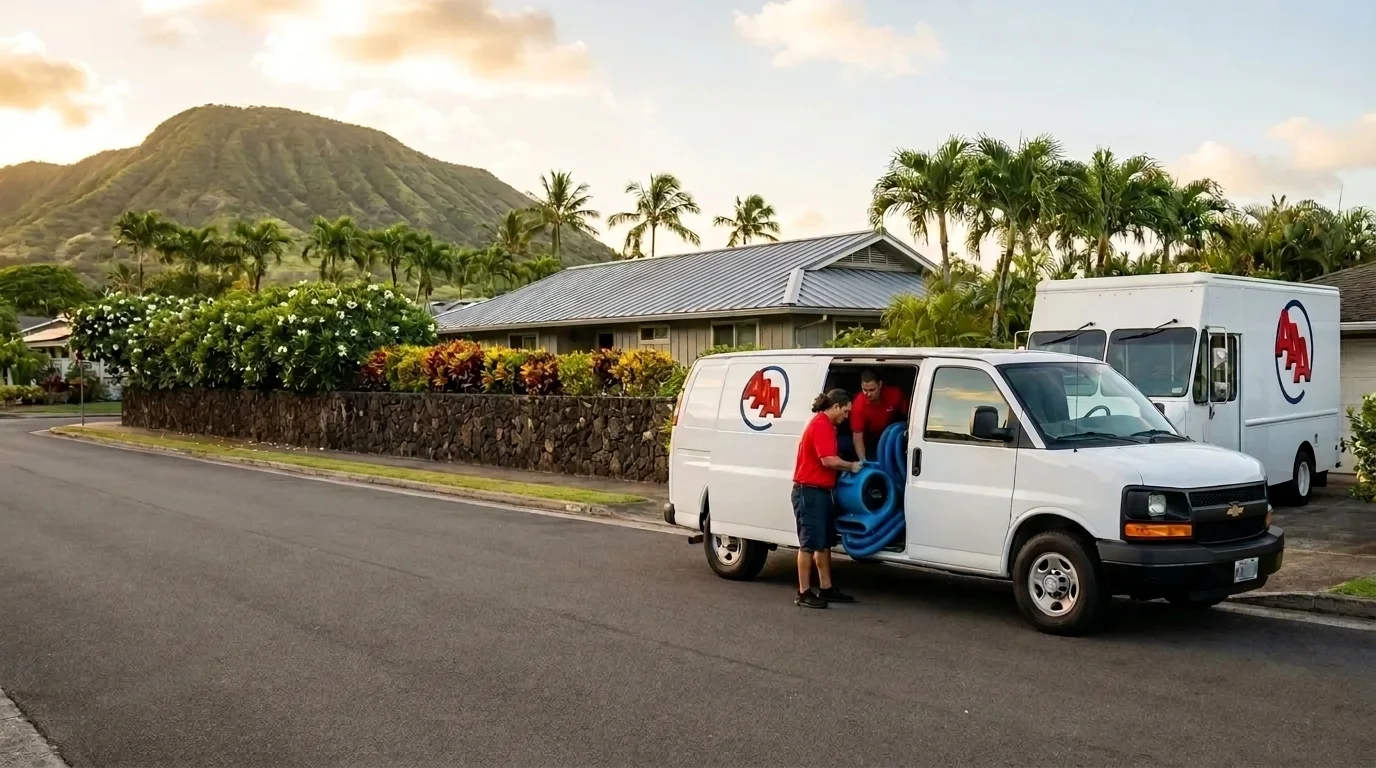
TL;DR: Oahu’s most flood-prone areas include Kaneohe and Kailua on the windward side (heavy Koolau rainfall, high water tables), the flat Ewa plain (poor drainage during Kona storms), and valley neighborhoods like Aina Haina and Palolo (steep ridges that funnel runoff). Flooding here hits slab-on-grade homes and single-wall cottages fast. If water enters your home, extract it within 24-48 hours, tropical humidity means mold can start in that window year-round.
You searched “flood areas Oahu” because you either just got water in your home, you’re buying property and want to know the risk, or you’ve heard your neighborhood mentioned and want the straight story. This guide covers the specific reasons each area floods, what FEMA’s flood maps show, and what to do the moment water comes in. Oahu homes are overwhelmingly slab-on-grade or single-wall construction, so the threat isn’t a flooded basement, it’s water across your living room floor, soaking into drywall from the bottom up.
Which parts of Oahu flood most often?
The windward side of Oahu, Kaneohe and Kailua especially, floods most often because the Koolau Range forces trade-wind clouds to drop enormous rainfall on the eastern slopes. The Ewa plain floods differently: it’s flat, drains poorly, and ponds water during Kona Low events. Valley neighborhoods like Aina Haina and Palolo flood when Kona storms push heavy rain down steep ridges faster than storm drains can handle.
Here’s a breakdown by area:
Kaneohe
Kaneohe is one of the wettest communities on Oahu. The Koolau’s windward face drops some of the highest annual rainfall totals on the island directly onto Kaneohe’s valleys. Roof leaks, hillside runoff, and chronically damp conditions are everyday realities here, not storm-season events. Kahaluu and Ahuimanu lots sit along streams that flood during flash-flood events. The National Weather Service Honolulu office issues flash-flood watches for this corridor regularly.
Homes in Kaneohe are mostly 1960s-70s subdivisions with original plumbing. When runoff enters a single-wall home, water wicks into wall cavities quickly. Mold pressure on the windward side is among the highest on Oahu, and it doesn’t wait for a major storm, a slow roof leak during a standard trade-wind shower can be enough.
If your home is in Kaneohe, see our Kaneohe flood damage restoration page for area-specific response.
Kailua
Kailua floods for a different set of reasons. The water table around Kawainui Marsh and Enchanted Lake sits close to the surface, so during sustained rain, groundwater rises and has nowhere to go. Canal-front homes in Kalama Tract flood when Kona storms stall over the Koolau and push water levels up through storm drains and into yards. Lanikai and Coconut Grove sit low enough that surge from Kailua Bay can compound the problem during major events.
Kailua’s dense vacation-rental and second-home inventory adds another wrinkle: owners are often off-island when a pipe lets go or storm water enters. Leaks run for days before anyone notices. By the time a neighbor calls, you’re dealing with soaked single-wall construction and active mold growth.
For Kailua-specific response, see our Kailua flood damage restoration page.
Ewa Beach and the Ewa Plain
The Ewa plain doesn’t get the rainfall that the windward side does, but its flat topography means water has nowhere to go when Kona storms hit. Ocean Pointe, Ewa Gentry, and Hoakalei are large slab-on-grade developments built on land that drains slowly. During heavy rain, water ponds against slabs, seeps through garage doors, and enters through weep holes and threshold gaps.
Ewa Beach homes are newer, 1990s through 2020s construction, but newer doesn’t mean waterproof. Tightly sealed modern homes trap moisture after a flood event. Without professional structural drying, that moisture stays in the slab and wall assemblies and becomes a mold problem within days.
See our Ewa Beach flood damage restoration page for coverage in that area.
Aina Haina and Palolo Valley
Aina Haina sits in a valley between Kahala and Hawaii Kai, backed up against steep ridges. When Kona storms push heavy rain from the south, runoff funnels down driveways and into garages and lower floors faster than it can drain. Flash-flood advisories along Kalanianaole Highway are a recurring reality. Palolo Valley homes face the same ridge-funnel dynamic on the mauka side of Kaimuki.
These are mostly 1950s-60s ranch homes with original galvanized plumbing. Single-wall redwood construction soaks up water and grows mold inside wall cavities quickly. The combination of fast-moving storm runoff and slow-drying wall assemblies makes rapid extraction critical.
Honolulu Valley Neighborhoods: Manoa and Nuuanu
Manoa Valley sits directly under one of the wettest ridgelines in urban Honolulu. Manoa Stream floods during heavy rain, and homes along the valley floor have seen repeated inundation. Nuuanu faces similar dynamics, with Nuuanu Stream channeling Koolau runoff through a dense residential corridor. Both neighborhoods have FEMA-designated Special Flood Hazard Areas (SFHAs), the 100-year floodplain designation that triggers mandatory flood insurance requirements for federally backed mortgages.
How do I check if my Oahu home is in a flood zone?
You can check your property’s flood zone designation using FEMA’s Flood Map Service Center. Enter your address and the tool returns your flood zone designation. Zone AE is the high-risk Special Flood Hazard Area. Zone X is moderate-to-low risk. Zone VE covers coastal areas with wave action risk.
FEMA’s maps are updated periodically but don’t always reflect recent development or drainage changes. Your flood zone designation affects whether your lender requires flood insurance and what that policy costs. Standard homeowners insurance does not cover flood damage, that’s a separate National Flood Insurance Program (NFIP) policy or a private flood policy.
If you want to understand what flood insurance actually covers before you need it, our post on flood insurance in Hawaii breaks down the NFIP coverage structure and what most homeowners’ policies exclude.
What should I do if floodwater enters my Oahu home?
If water enters your home, the 24-48 hour window is the one that matters. In Hawaii’s tropical humidity, soaked drywall and carpet can show visible mold growth within that window year-round. This is faster than almost any mainland market.
Here’s what to do immediately:
- Stop the source if you can. If it’s a pipe failure, shut off the main. If it’s storm water, you can’t stop the rain, but you can sandbag doorways or redirect flow with towels and buckets while you call for help.
- Don’t walk through standing water if there’s any electrical risk. Slab-on-grade homes can have outlets close to floor level. If water is near outlets, breakers, or appliances, cut power to the affected area first.
- Document everything before you touch it. Photos and video of the water level, affected materials, and the source (if visible) protect your insurance claim. Your insurer will ask for this.
- Call for extraction immediately. Consumer fans and shop vacs don’t dry structural materials, they move surface water and leave moisture in the slab, wall cavities, and subfloor. Professional extraction equipment pulls water out of the material, not just off the surface.
- Contact your insurance company. Flood damage from storm water is typically covered under a separate flood policy, not your homeowners policy. If you have an NFIP policy, file the claim as soon as possible, there are documentation requirements that affect payout.
For a full first-response checklist, see our post on what to do in the first 24 hours after water damage.
Does Oahu flood often enough to worry about it?
Oahu floods every year. The question is whether it floods where you are. Windward communities like Kaneohe and Kailua see flash-flood watches and warnings multiple times annually. Kona Low events, which typically form between October and April, bring the heaviest rain to leeward and valley areas, Ewa, Aina Haina, Manoa, and Nuuanu. August and September bring elevated tropical moisture and occasional tropical cyclone remnants that can dump rain across the entire island in hours.
Oahu’s slab-on-grade and single-wall construction means flood water enters fast and dries slowly without professional equipment. There’s no basement to pump out, water enters at grade and spreads across finished floors immediately.
If you’re in a flood-prone area and haven’t checked your flood zone designation or flood insurance status, before the next Kona Low season is the right time to do it.
About AAA Water Damage Restoration & Carpet Care
AAA Water Damage Restoration & Carpet Care (AAA Flood Service LLC) has served Oahu for over 25 years, responding 24/7 to flood damage, water damage, sewage cleanup, mold remediation, and related losses across the island. Their crews handle flood extraction and structural drying in Kaneohe, Kailua, Ewa Beach, Aina Haina, Honolulu, and surrounding communities. Reach them at (808) 349-3407.